
Bosnia & Herzegovina: landmarks, animals & facts for kids
1 landmark
Bosnia & Herzegovina on My Earth Toy, the free 3D toy globe for kids: 1 landmark. Here you can see its flag, capital and size, then fly to every place on the globe.
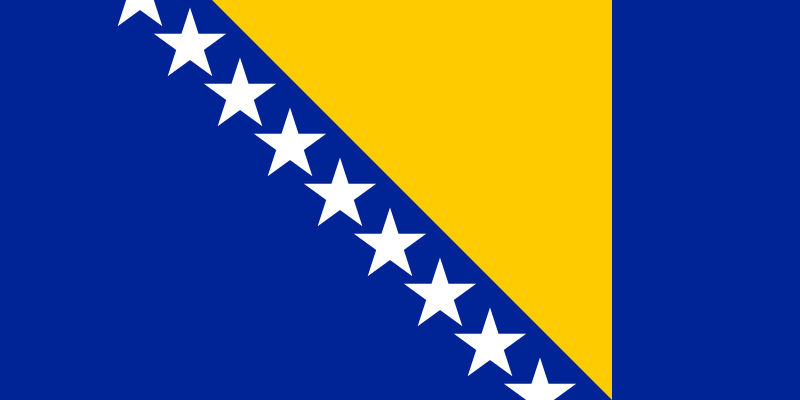
The flag of Bosnia and Herzegovina is blue with a large yellow triangle and a diagonal row of white stars running along its long side.
Read about this flag →Bosnia & Herzegovina at a glance
- Capital
- Sarajevo
- Continent
- Europe
- Area
- 51,197 km²
- Population
- 3.2 million
Bosnia and Herzegovina is a mountainous country in southeastern Europe, on the Balkan Peninsula. It is almost landlocked, touching the Adriatic Sea only along a tiny strip of coast at Neum. Its capital is Sarajevo, and about 3 million people live there. The country is known for green mountains, emerald rivers, Ottoman-era bridges and old towns, and a mix of cultures and faiths.
On My Earth Toy you can see the Stari Most, the Old Bridge of Mostar. This graceful stone arch over the Neretva River was built in the 1500s, destroyed during the war in 1993, and carefully rebuilt using the original methods.
Geography and nature
The Dinaric Alps cover much of the country, with forests, high meadows and deep river canyons. The north opens onto the plains of the Sava River. Herzegovina, in the south, is warmer and rockier, with a Mediterranean feel. Rivers such as the Una, Drina and Neretva are famous for their clear green water. Sutjeska National Park protects Perućica, one of the last primeval forests in Europe, and brown bears and wolves still live in the mountains.
People, languages and culture
The three main groups are Bosniaks, Serbs and Croats. They speak Bosnian, Serbian and Croatian, which are very similar and can be written in Latin or Cyrillic letters. Mosques, Orthodox and Catholic churches and synagogues stand close together in Sarajevo. Ćevapi, small grilled sausages served in flatbread with onions, are a favourite food, and strong coffee is served in small copper pots. Sevdalinka is a traditional, emotional style of song.
History in a nutshell
In the Middle Ages there was a Bosnian kingdom. The Ottoman Empire ruled the region from the 1400s for about four centuries and built bridges, mosques and bazaars. In 1878 Austria-Hungary took control, and in 1914 the assassination of Archduke Franz Ferdinand in Sarajevo helped spark World War I. Later the country was part of Yugoslavia. It declared independence in 1992; a war followed until the Dayton Agreement of 1995.
Fun facts
- Divers jump from the Stari Most into the Neretva River, a tradition that goes back centuries.
- Sarajevo hosted the Winter Olympic Games in 1984.
- Bosnia and Herzegovina's coastline at Neum is only about 20 kilometres long.
- The Old Bridge area of Mostar is a UNESCO World Heritage Site.
Famous landmarks in Bosnia & Herzegovina
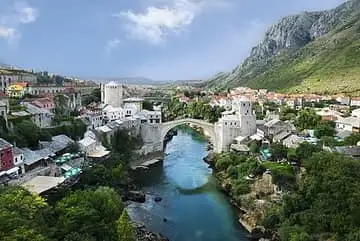
Stari Most, Mostar
Bosnia & Herzegovina · Europe
An Ottoman stone bridge arching 24 m above the Neretva; destroyed in the 1993 war and rebuilt in 2004.
Questions
What is the capital of Bosnia & Herzegovina?
The capital of Bosnia & Herzegovina is Sarajevo.
Which continent is Bosnia & Herzegovina in?
Bosnia & Herzegovina is in Europe.
How big is Bosnia & Herzegovina?
Bosnia & Herzegovina covers about 51,197 km².
How many people live in Bosnia & Herzegovina?
About 3.2 million people live in Bosnia & Herzegovina.
What are the most famous landmarks in Bosnia & Herzegovina?
On My Earth Toy's free 3D globe, the landmark from Bosnia & Herzegovina is Stari Most, Mostar, with a photo and quick facts.
Sources
Updated: 2026-10-30