
Kyrgyzstan: landmarks, animals & facts for kids
1 landmark
Kyrgyzstan on My Earth Toy, the free 3D toy globe for kids: 1 landmark. Here you can see its flag, capital and size, then fly to every place on the globe.
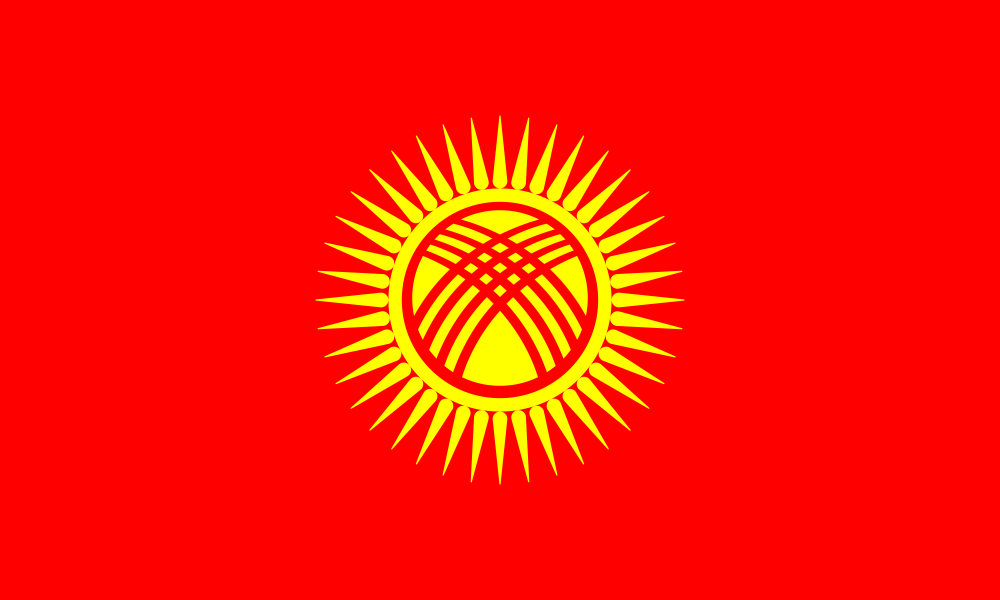
A red flag with a golden sun in the middle that has 40 straight rays; inside the sun is the red crossed-lattice roof of a yurt.
Read about this flag →Kyrgyzstan at a glance
- Capital
- Bishkek
- Continent
- Asia
- Area
- 199,951 km²
- Population
- 7.2 million
Kyrgyzstan is a landlocked country in Central Asia, bordered by Kazakhstan, Uzbekistan, Tajikistan and China. Its capital is Bishkek. Almost the whole country is mountainous: most of it lies more than 1,000 metres above sea level, among the high peaks of the Tian Shan range. Kyrgyzstan is known for its alpine lakes, summer pastures dotted with yurts, horse riding and the long Kyrgyz epic poem Manas.
On My Earth Toy you can visit the Burana Tower near the town of Tokmok, an 11th-century brick minaret that is one of the last remains of the old Silk Road city of Balasagun.
Geography and nature
The Tian Shan mountains cover much of Kyrgyzstan, with glaciers, deep valleys and high grasslands. The highest peak, Jengish Chokusu (Victory Peak), reaches 7,439 metres on the border with China. Issyk-Kul, a huge, slightly salty mountain lake, never freezes even though it sits high in cold mountains. In the south, Arslanbob has one of the largest natural walnut forests in the world. Snow leopards, ibex and argali sheep live in the high mountains.
People, languages and culture
Kyrgyz is the state language and Russian is also official; Uzbek is spoken by many people in the south. Most Kyrgyzstanis are Muslim. Nomadic traditions are still strong: families take their herds to summer pastures and live in yurts, and men often wear the tall white felt hat called the kalpak. Kok-boru, a rough team game played on horseback, is very popular. The epic Manas, recited from memory by storytellers called manaschi, tells of a hero who united the Kyrgyz people.
History in a nutshell
For centuries, Silk Road caravans crossed the region between China and the west. In the 10th to 12th centuries, Balasagun was a capital of the Karakhanid state, and the Burana Tower was built there. Later the area was ruled by the Mongols and then by the Kokand Khanate. In the 19th century the Russian Empire took control, and in the 20th century it became a Soviet republic. Kyrgyzstan became independent on 31 August 1991.
Fun facts
- The red flag of Kyrgyzstan shows a tunduk, the round wooden crown at the top of a yurt.
- Issyk-Kul means warm lake, because it does not freeze in winter.
- The Manas epic is one of the longest epic poems in the world.
- Kyrgyzstan has hosted the World Nomad Games, with horseback sports, eagle hunting and wrestling.
Famous landmarks in Kyrgyzstan
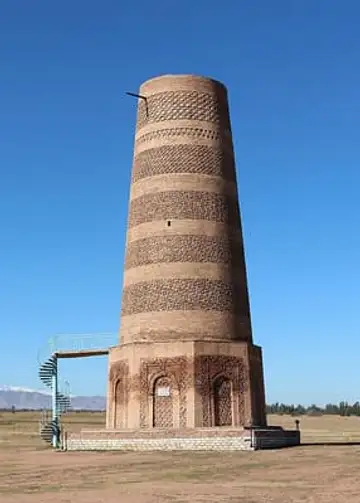
Burana Tower
Kyrgyzstan · Asia
The Burana Tower is an 11th-century brick minaret, all that stands of the Karakhanid city of Balasagun.
Questions
What is the capital of Kyrgyzstan?
The capital of Kyrgyzstan is Bishkek.
Which continent is Kyrgyzstan in?
Kyrgyzstan is in Asia.
How big is Kyrgyzstan?
Kyrgyzstan covers about 199,951 km².
How many people live in Kyrgyzstan?
About 7.2 million people live in Kyrgyzstan.
What are the most famous landmarks in Kyrgyzstan?
On My Earth Toy's free 3D globe, the landmark from Kyrgyzstan is Burana Tower, with a photo and quick facts.
Sources
Updated: 2026-10-30