
Moldova: landmarks, animals & facts for kids
1 landmark
Moldova on My Earth Toy, the free 3D toy globe for kids: 1 landmark. Here you can see its flag, capital and size, then fly to every place on the globe.
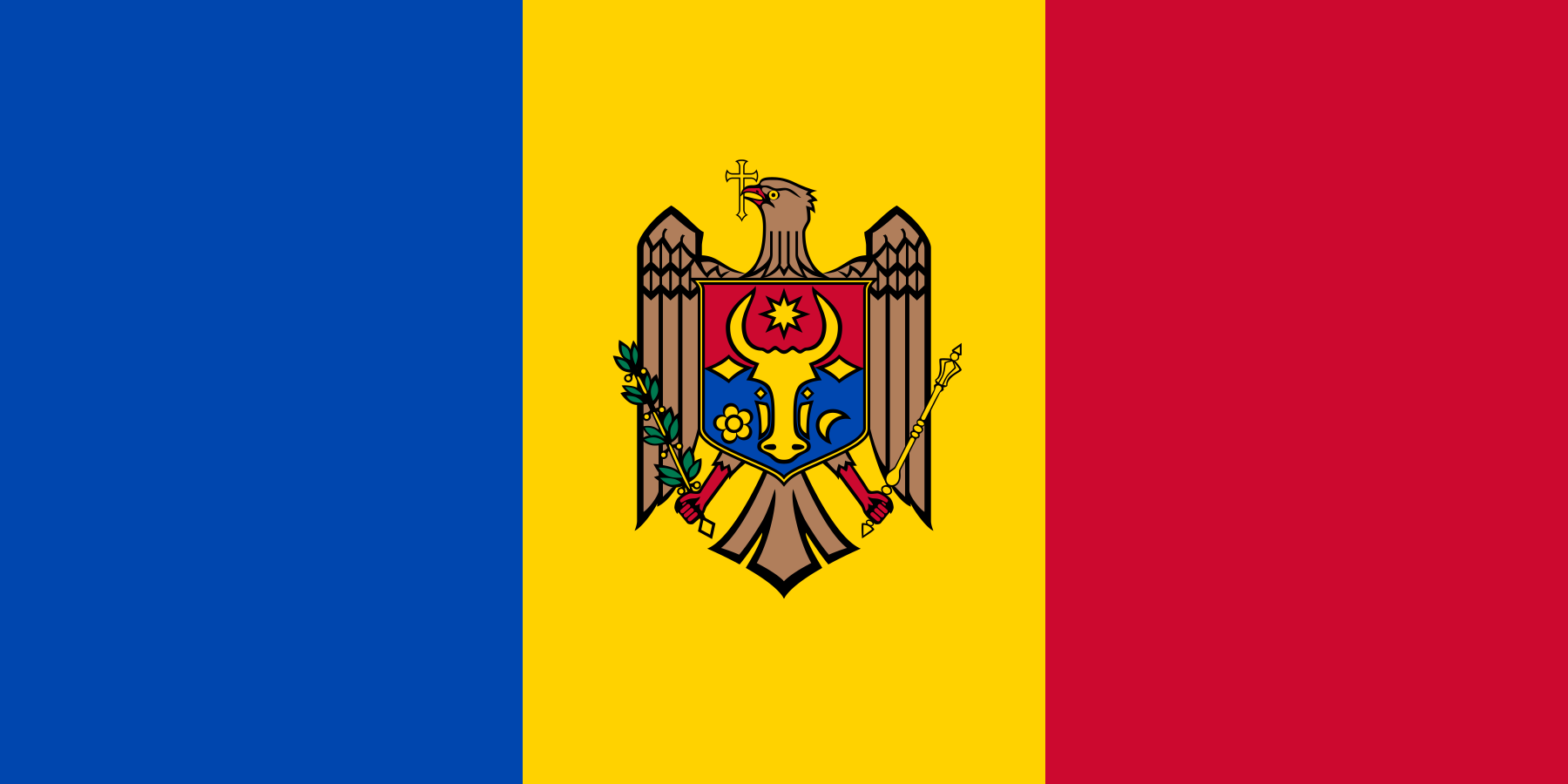
Three vertical stripes of blue, yellow and red, with the coat of arms, a brown eagle holding a cross, in the middle of the yellow stripe.
Read about this flag →Moldova at a glance
- Capital
- Chișinău
- Continent
- Europe
- Area
- 33,846 km²
- Population
- 3 million
Moldova is a small landlocked country in Eastern Europe, between Romania to the west and Ukraine to the north, east and south. Its capital is Chișinău. Moldova is a land of gentle green hills, fertile black soil, orchards and vineyards, and it is famous for its wine and for some of the biggest underground wine cellars in the world. Most people speak Romanian, and the country shares much of its history and culture with Romania.
On My Earth Toy you can see the Triumphal Arch in central Chișinău, built in 1840 to celebrate a Russian victory over the Ottoman Empire, which stands opposite the city's Orthodox cathedral.
Geography and nature
Moldova lies between two rivers: the Prut, which forms the border with Romania, and the Dniester in the east. The land is mostly rolling hills cut by river valleys; the highest point, Bălănești Hill, is only 430 metres high. Moldova's dark, rich soil, called chernozem, is excellent for farming grapes, sunflowers, apples and walnuts. In the Răut River valley, the old cave monastery of Orheiul Vechi is carved into a limestone cliff.
People, languages and culture
The official language is Romanian, and Russian is also widely spoken; the Gagauz people in the south speak a Turkic language and have their own autonomous region. Most Moldovans are Orthodox Christians. On 1 March, people give each other mărțișor, small red-and-white tokens that welcome spring, a custom listed by UNESCO. Favourite foods include mămăligă, a cornmeal porridge, and plăcinte, pastries filled with cheese, cabbage or fruit.
History in a nutshell
In the 14th century the Principality of Moldavia was founded, and its best-known ruler, Stephen the Great, defended it against powerful neighbours. Moldavia later had to accept Ottoman overlordship. In 1812 the eastern part, called Bessarabia, was taken by the Russian Empire. It joined Romania in 1918, then became part of the Soviet Union. Moldova declared independence on 27 August 1991. Since the early 1990s, the region of Transnistria east of the Dniester has had its own government that is not internationally recognised.
Fun facts
- The wine cellars of Mileștii Mici hold the largest wine collection in the world, according to Guinness World Records, with about two million bottles.
- The underground streets of the Cricova winery are so long that visitors tour them by car.
- Mărțișor, the 1 March spring tradition, is shared by Moldova, Romania, Bulgaria and North Macedonia.
- Moldova's flag looks very similar to Romania's, but has a coat of arms with an eagle in the middle.
Famous landmarks in Moldova
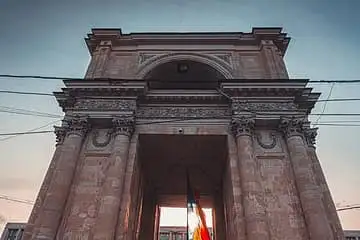
Triumphal Arch, Chișinău
Moldova · Europe
A stone arch built in 1840 to mark victory in the Russo-Turkish War; it stands at the entrance of Cathedral Park facing the Government House, with a large bell in its upper stage.
Questions
What is the capital of Moldova?
The capital of Moldova is Chișinău.
Which continent is Moldova in?
Moldova is in Europe.
How big is Moldova?
Moldova covers about 33,846 km².
How many people live in Moldova?
About 3 million people live in Moldova.
What are the most famous landmarks in Moldova?
On My Earth Toy's free 3D globe, the landmark from Moldova is Triumphal Arch, Chișinău, with a photo and quick facts.
Sources
Updated: 2026-10-30