
Montenegro: landmarks, animals & facts for kids
1 landmark
Montenegro on My Earth Toy, the free 3D toy globe for kids: 1 landmark. Here you can see its flag, capital and size, then fly to every place on the globe.
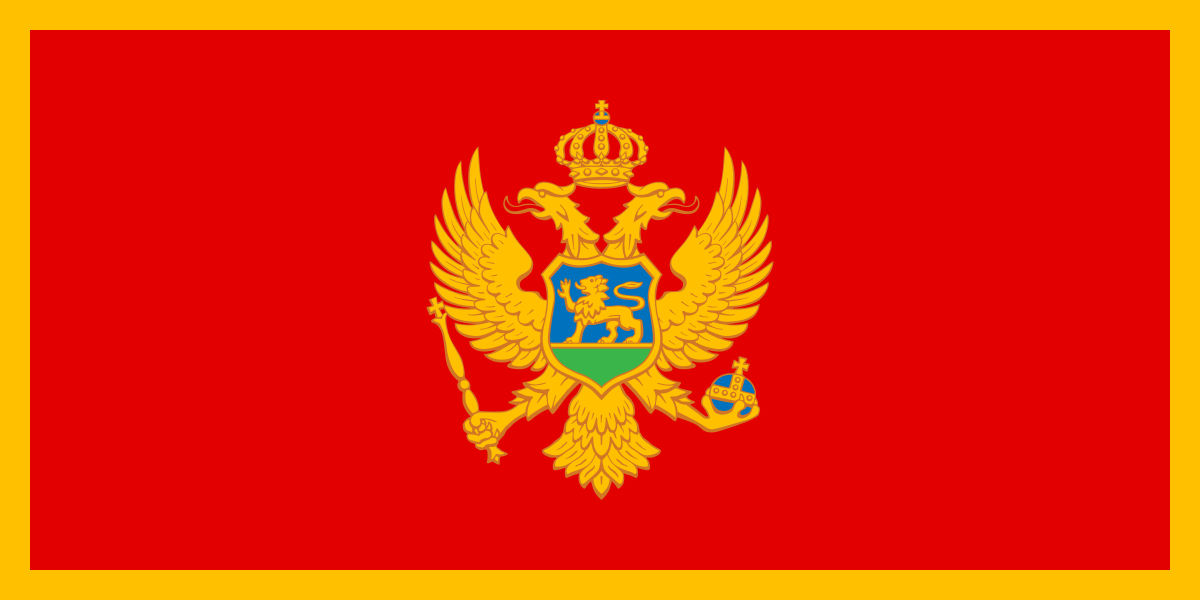
A red flag with a gold border and the gold coat of arms, a crowned double-headed eagle with a lion on its chest, in the centre.
Read about this flag →Montenegro at a glance
- Capital
- Podgorica
- Continent
- Europe
- Area
- 13,812 km²
- Population
- 0.6 million
Montenegro is a small country in southeastern Europe on the Adriatic Sea, bordered by Croatia, Bosnia and Herzegovina, Serbia, Kosovo and Albania. Its capital is Podgorica, while the old royal capital, Cetinje, is still an important cultural centre. The name Montenegro means black mountain, after the dark forested peaks that cover much of the country. It is known for its dramatic Bay of Kotor, walled coastal towns, deep canyons and mountain lakes.
On My Earth Toy you can visit Our Lady of the Rocks, a tiny artificial island in the Bay of Kotor, off the town of Perast, with a blue-domed church on it.
Geography and nature
Although Montenegro is small, its landscape changes from sunny beaches to high mountains in a short distance. The Bay of Kotor winds deep into the land between steep mountains. Inland, Durmitor National Park has glacial lakes and the Tara River Canyon, one of the deepest canyons in Europe. Lake Skadar, shared with Albania, is the largest lake in the Balkans and a haven for pelicans and other birds. The highest peak, Zla Kolata, reaches 2,534 metres.
People, languages and culture
Montenegrin is the official language, and Serbian, Bosnian, Albanian and Croatian are also used. Most people are Orthodox Christians, with Muslim and Catholic communities too. Montenegrins love storytelling, poetry and the gusle, a one-stringed instrument used to accompany heroic songs. Coastal towns such as Kotor and Budva have old stone streets inside medieval walls, and the walled town of Kotor is a UNESCO World Heritage Site. Montenegro uses the euro even though it is not in the European Union.
History in a nutshell
In the Middle Ages the area was part of the states of Duklja and Zeta. When the Ottoman Empire expanded, the mountain region around Cetinje kept a large degree of self-rule, led for a long time by prince-bishops of the Petrović-Njegoš family. Montenegro's independence was recognised at the Congress of Berlin in 1878, and it became a kingdom in 1910. After 1918 it was part of Yugoslavia and later joined with Serbia. Montenegro became independent again on 3 June 2006 after a referendum.
Fun facts
- Our Lady of the Rocks was built up from the sea by local sailors placing rocks and sinking old ships, and every 22 July people still row out to throw stones around it.
- The Tara River Canyon is about 1,300 metres deep at its deepest point.
- Sveti Stefan is a tiny island village joined to the mainland by a narrow strip of sand.
- The Bay of Kotor is often called Europe's southernmost fjord, but geologists say it is really a river canyon that was flooded by the sea.
Famous landmarks in Montenegro
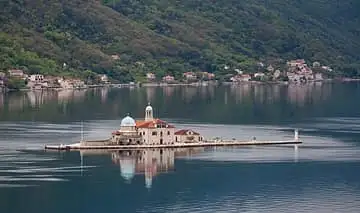
Our Lady of the Rocks
Montenegro · Europe
An artificial islet off Perast in the Bay of Kotor, built up by sailors dropping rocks over centuries, crowned by a church with a sky-blue dome.
Questions
What is the capital of Montenegro?
The capital of Montenegro is Podgorica.
Which continent is Montenegro in?
Montenegro is in Europe.
How big is Montenegro?
Montenegro covers about 13,812 km².
How many people live in Montenegro?
About 0.6 million people live in Montenegro.
What are the most famous landmarks in Montenegro?
On My Earth Toy's free 3D globe, the landmark from Montenegro is Our Lady of the Rocks, with a photo and quick facts.
Sources
Updated: 2026-10-30