
Mozambique: landmarks, animals & facts for kids
1 landmark · 1 animal
Mozambique on My Earth Toy, the free 3D toy globe for kids: 1 landmark, 1 animal. Here you can see its flag, capital and size, then fly to every place on the globe.
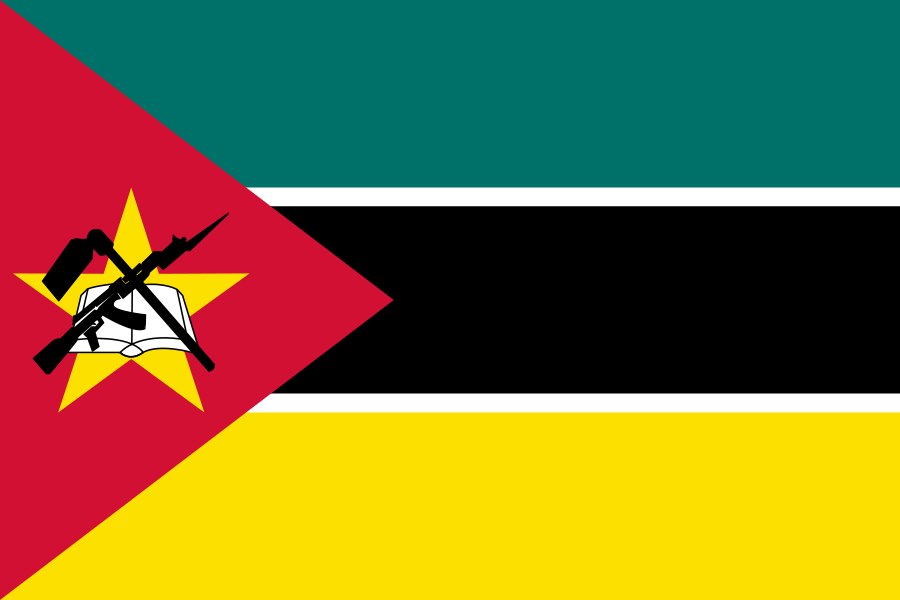
Mozambique's flag has green, black and yellow stripes edged in white, and a red triangle at the pole with a yellow star, an open book, a hoe and a rifle.
Read about this flag →Mozambique at a glance
- Capital
- Maputo
- Continent
- Africa
- Area
- 801,590 km²
- Population
- 34.6 million
Mozambique is a country in southeastern Africa with a long coastline of about 2,500 kilometres on the Indian Ocean, facing the island of Madagascar across the Mozambique Channel. Its capital, Maputo, lies in the far south. Mozambique is known for its tropical beaches, coral reefs and islands, the great Zambezi River, Portuguese-influenced towns and spicy seafood.
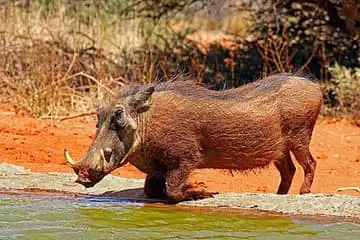
On My Earth Toy you can see Maputo Central Railway Station, an elegant station from 1910 with a green metal dome, often counted among the most beautiful railway stations in the world. Look for the common warthog, a wild pig with curved tusks that kneels on its front legs to graze.
Geography and nature
Mozambique has wide coastal lowlands, rising inland to plateaus and mountains near the borders with Zimbabwe and Malawi, where Monte Binga reaches 2,436 metres. The Zambezi River crosses the centre of the country, and the Cahora Bassa Dam on it forms a large lake. Off the coast, the Bazaruto Archipelago is home to dugongs, sea turtles and coral reefs, while whale sharks and manta rays visit the waters near Tofo. Gorongosa National Park has been restoring its wildlife after years of decline.
People, languages and culture
Portuguese is the official language, but most people first learn one of many African languages, such as Makhuwa, Tsonga, Sena or Nyanja. Christianity is the largest religion, and Islam is common in the north and along the coast. The Chopi people play the timbila, a wooden xylophone, in large orchestras, a tradition listed by UNESCO. People often wear capulanas, colourful printed cloths. Seafood with peri-peri chilli sauce and matapa, a stew of cassava leaves and peanuts, are popular dishes.
History in a nutshell
Bantu-speaking farmers settled the region about 2,000 years ago. Coastal towns traded gold and ivory from the interior with Arab, Persian and Indian merchants across the Indian Ocean. The Portuguese explorer Vasco da Gama arrived in 1498, and Portugal gradually took control, making the Island of Mozambique its early capital. After a ten-year war for independence led by FRELIMO, Mozambique became independent on 25 June 1975. A long civil war followed and ended with a peace agreement in 1992.
Fun facts
- Maputo's railway station is often said to have been designed by Gustave Eiffel, but its real architects were Portuguese.
- Mozambique's flag is the only national flag that shows a modern rifle, crossed with a hoe and resting on a book.
- The country takes its name from the Island of Mozambique, a small coral island whose old town is a UNESCO World Heritage Site.
- Dugongs, gentle sea mammals related to manatees, graze on seagrass around the Bazaruto islands.
Famous landmarks in Mozambique
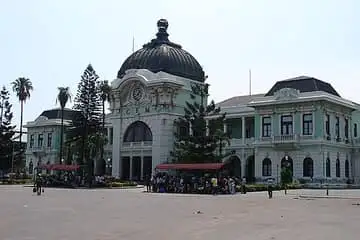
Maputo Central Railway Station
Mozambique · Africa
A 1916 railway station with a verdigris dome and pale cream walls trimmed in green, often listed among the most beautiful stations in the world.
Animals in Mozambique
Questions
What is the capital of Mozambique?
The capital of Mozambique is Maputo.
Which continent is Mozambique in?
Mozambique is in Africa.
How big is Mozambique?
Mozambique covers about 801,590 km².
How many people live in Mozambique?
About 34.6 million people live in Mozambique.
What are the most famous landmarks in Mozambique?
On My Earth Toy's free 3D globe, the landmark from Mozambique is Maputo Central Railway Station, with a photo and quick facts.
Which animals can you find in Mozambique on My Earth Toy?
On the globe you can find Common warthog in Mozambique.
Sources
Updated: 2026-10-30