
Senegal: landmarks, animals & facts for kids
1 landmark
Senegal on My Earth Toy, the free 3D toy globe for kids: 1 landmark. Here you can see its flag, capital and size, then fly to every place on the globe.
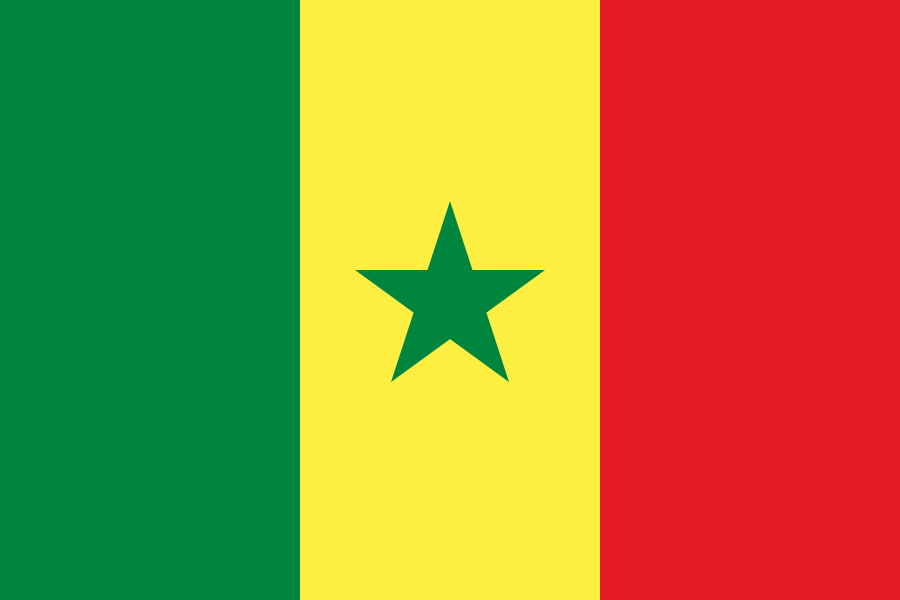
Three vertical stripes of green, yellow and red, with a small green five-pointed star in the middle of the yellow stripe.
Read about this flag →Senegal at a glance
- Capital
- Dakar
- Continent
- Africa
- Area
- 196,722 km²
- Population
- 18.5 million
Senegal is a country in West Africa on the Atlantic coast. Its capital, Dakar, sits on the Cap-Vert peninsula, the westernmost point of mainland Africa. Senegal borders Mauritania, Mali, Guinea and Guinea-Bissau, and it almost completely wraps around the small country of The Gambia.
Senegal is known for its warm welcome, called teranga, its lively music and wrestling, and its long history as a meeting place of trade routes and peoples. On the globe you can find the African Renaissance Monument, a giant bronze statue of a family standing on a hill above Dakar and looking out to the Atlantic Ocean.
Geography and nature
Senegal is mostly low and flat. The Senegal River forms the northern border, and the Gambia and Casamance rivers flow through the south. The dry north belongs to the Sahel, while the south is greener, with forests, mangroves and rice fields. Giant baobab trees dot the savanna. Near Dakar, Lake Retba, the 'Pink Lake', sometimes looks pink because of tiny algae in its salty water. Niokolo-Koba National Park shelters chimpanzees, lions and hippos, and the Djoudj sanctuary hosts millions of migrating birds.
People, languages and culture
French is the official language, but Wolof is spoken by most people, alongside Pulaar, Serer, Diola and others. Most Senegalese are Muslim, many belonging to Sufi brotherhoods, and there is a Christian minority. Music is everywhere, from sabar drums to mbalax, a popular style made famous by Youssou N'Dour. Traditional wrestling, called laamb, fills stadiums. The national dish is thieboudienne, fish cooked with rice, tomatoes and vegetables. Sharing food from one big bowl is common.
History in a nutshell
Over centuries, parts of Senegal belonged to great West African states such as the Ghana and Mali empires and the Jolof kingdom. From the 1400s European traders arrived, and Gorée Island off Dakar became a symbol of the Atlantic slave trade. France gradually took control, and Saint-Louis and later Dakar served as capitals of French West Africa. Senegal became independent in 1960, with the poet Léopold Sédar Senghor as its first president.
Fun facts
- The African Renaissance Monument is about 49 metres tall, often called the tallest statue in Africa.
- For many years the famous Paris-Dakar Rally ended at the Pink Lake near Dakar.
- Gorée Island is a UNESCO World Heritage Site that helps people remember the history of the slave trade.
- Senegal's first president, Léopold Sédar Senghor, was also a celebrated poet.
Famous landmarks in Senegal
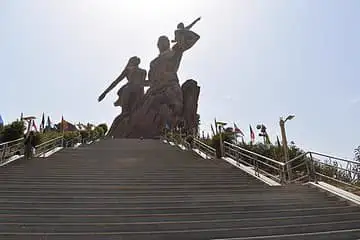
African Renaissance Monument
Senegal · Africa
A giant bronze statue on a hill above Dakar, symbolising Africa's rise; one of Africa's tallest statues.
Questions
What is the capital of Senegal?
The capital of Senegal is Dakar.
Which continent is Senegal in?
Senegal is in Africa.
How big is Senegal?
Senegal covers about 196,722 km².
How many people live in Senegal?
About 18.5 million people live in Senegal.
What are the most famous landmarks in Senegal?
On My Earth Toy's free 3D globe, the landmark from Senegal is African Renaissance Monument, with a photo and quick facts.
Sources
Updated: 2026-10-30