
Famous landmarks in Tunisia
3 landmarks · 1 place to discover
Tunisia on My Earth Toy, the free 3D toy globe for kids: 3 landmarks, 1 place to discover. Here you can see its flag, capital and size, then fly to every place on the globe.
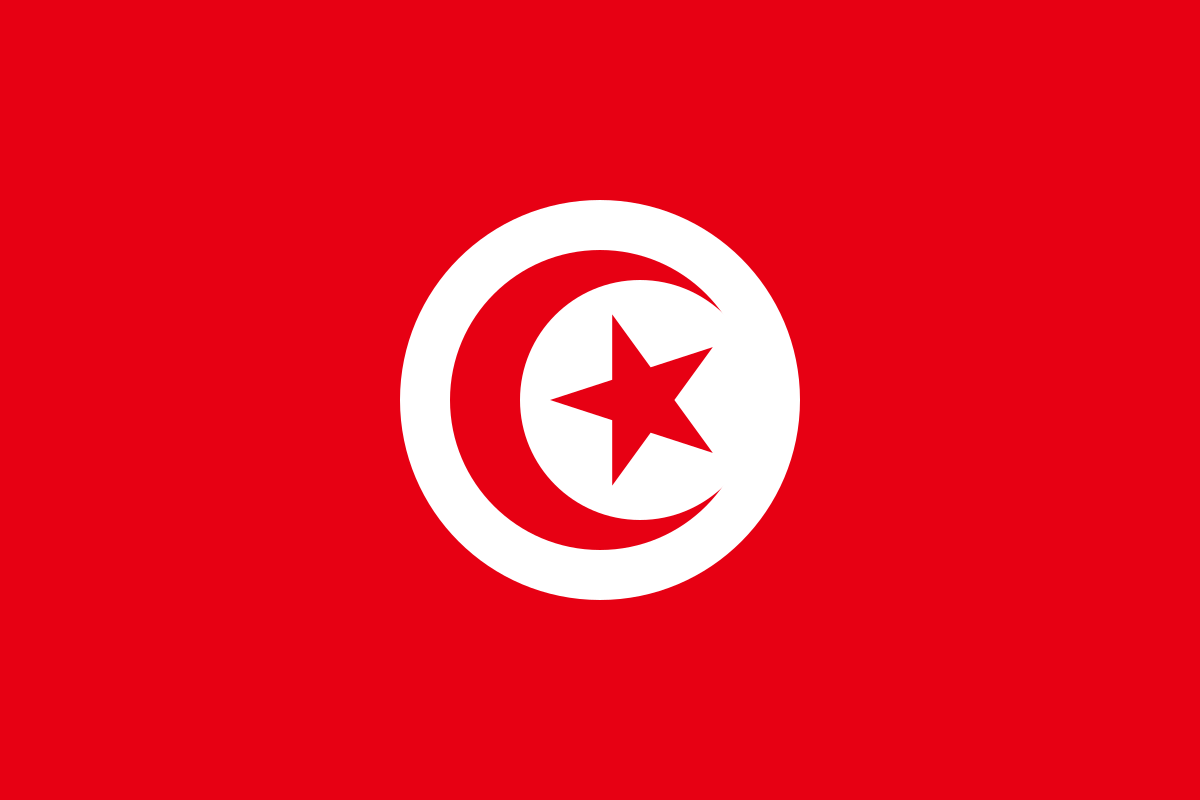
A red flag with a white circle in the middle. Inside the circle is a red crescent moon wrapped around a red five-pointed star.
Read about this flag →Tunisia at a glance
- Capital
- Tunis
- Continent
- Africa
- Area
- 163,610 km²
- Population
- 12.3 million
Tunisia is a country in North Africa on the Mediterranean Sea. It is the northernmost country in Africa, and it borders Algeria to the west and Libya to the south-east. Its capital, Tunis, lies near the ruins of ancient Carthage. Tunisia has long sandy beaches in the north and east and the Sahara Desert in the south.
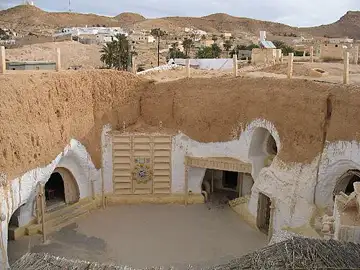
Tunisia is known for its ancient Roman ruins, whitewashed villages, olive groves and desert landscapes. On the globe you can find the Amphitheatre of El Jem, the Great Mosque of Kairouan and the Antonine Baths of Carthage, plus Matmata, where underground homes appeared in the Star Wars films.
Geography and nature
Northern Tunisia is green, with forests of cork oak and the eastern end of the Atlas Mountains. The centre has steppes and huge olive groves; Tunisia is one of the world's biggest producers of olive oil. Further south, the land turns to desert. Chott el Djerid is a vast salt flat that shimmers with mirages, and beyond it lie the dunes of the Sahara. Off the coast is the island of Djerba. Fennec foxes, desert gazelles and flamingos live in different parts of the country.
People, languages and culture
Arabic is the official language, and people speak Tunisian Arabic every day; French is widely used, and some people speak Berber languages. Almost all Tunisians are Muslim. Couscous is a beloved dish, along with brik, a crispy pastry with egg, and harissa, a spicy red pepper paste. The village of Sidi Bou Said, with its white walls and bright blue doors, is famous. Tunisians enjoy mint tea with pine nuts, and markets called souks sell carpets, pottery and spices.
History in a nutshell
Phoenician sailors founded Carthage about 2,800 years ago, and it became a great sea power; its general Hannibal crossed the Alps with elephants to attack Rome. Rome destroyed Carthage in 146 BCE and later rebuilt it, and Roman towns such as El Jem flourished. In the 600s Arab armies brought Islam and founded Kairouan. Tunisia later came under the Ottoman Empire, then France from 1881. It became independent on 20 March 1956. In 2011 a popular uprising in Tunisia began the movement known as the Arab Spring.
Fun facts
- The Amphitheatre of El Jem could hold about 35,000 spectators, making it one of the largest Roman amphitheatres in the world.
- The Great Mosque of Kairouan, founded in 670, is one of the oldest mosques in Africa.
- George Lucas named Luke Skywalker's home planet Tatooine after the Tunisian town of Tataouine.
- Four Tunisian groups that helped the country through a political crisis won the Nobel Peace Prize in 2015.
Famous landmarks in Tunisia
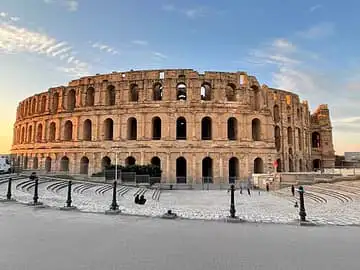
Amphitheatre of El Jem
Tunisia · Africa
The largest Roman amphitheatre in North Africa, remarkably well preserved.
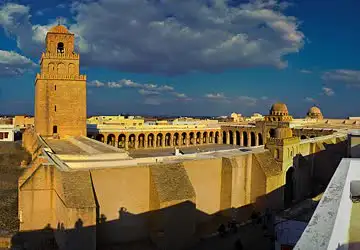
Great Mosque of Kairouan
Tunisia · Africa
Founded in 670, one of North Africa's oldest mosques, known for its massive three-tier square minaret.
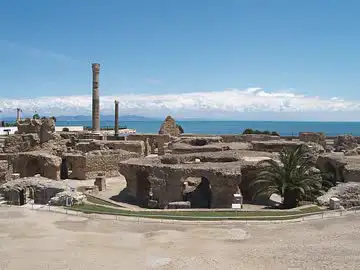
Carthage – Antonine Baths
Tunisia · Africa
Seaside ruins of the largest Roman baths in Africa, marked by a single re-erected towering column.
Places to discover in Tunisia
Questions
What is the capital of Tunisia?
The capital of Tunisia is Tunis.
Which continent is Tunisia in?
Tunisia is in Africa.
How big is Tunisia?
Tunisia covers about 163,610 km².
How many people live in Tunisia?
About 12.3 million people live in Tunisia.
What are the most famous landmarks in Tunisia?
Some of the best-known landmarks in Tunisia are Amphitheatre of El Jem, Great Mosque of Kairouan and Carthage – Antonine Baths. My Earth Toy has 3 landmarks from Tunisia on its free 3D globe, each with a photo and quick facts.
Sources
Updated: 2026-10-30