
Jiuzhaigou Valley
주자이거우 (구채구)
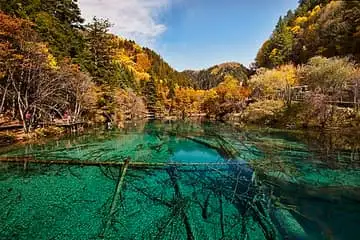
Nature reserve and UNESCO site in Sichuan, China, famous for turquoise lakes stepped behind travertine dams and wide multi-level waterfalls such as Nuorilang, among Tibetan villages.
See it on the 3D globe →At a glance
- Country
- China
- Type
- Park
Quick answers
Where is Jiuzhaigou Valley?
Jiuzhaigou Valley is in China.
Jiuzhaigou is a nature reserve and national park in northern Sichuan Province, southwestern China. It is a long valley running north to south in the Min Mountains, on the edge of the Tibetan Plateau, famous for its many-step waterfalls, colorful lakes and snow-capped peaks. UNESCO made it a World Heritage Site in 1992 and a World Biosphere Reserve in 1997.
The valley area covers 720 square kilometres, with another 600 square kilometres as a buffer zone. Its height ranges from about 2,000 metres at the entrance to more than 4,500 metres at the top of Zechawa Gully. The name means 'Nine Settlement Valley', after the nine Tibetan villages along it. The globe marks it as a scenic valley with turquoise lakes.
A hidden valley discovered by visitors
Tibetan and Qiang peoples lived here for centuries, but the area was little known to outsiders until 1975. That year, forestry scientist Wu Zhonglun surveyed it, was moved by its beauty and wrote to the authorities asking them to stop logging.
Logging was halted and Jiuzhaigou Nature Reserve was set up in 1980. The site opened to tourists in 1984, with 5,000 visitors that year. In 2024 it welcomed 5.11 million, and timed tickets limit it to 41,000 visitors a day.
Forests and wildlife
Nearly 300 square kilometres of the core area is virgin mixed forest, which turns yellow, orange and red in autumn. Unusual plants here include local kinds of rhododendron and bamboo.
The valley is home to endangered giant pandas and golden snub-nosed monkeys, but each group is very small, with fewer than 20 pandas. It is one of only three known places for the threatened Duke of Bedford's vole, and about 140 bird species live here.
The 2017 earthquake
In August 2017, a magnitude 7.0 earthquake struck Jiuzhaigou County and caused major damage. The valley was closed to tourists until March 3, 2018, and then reopened with limited access.
The shaking broke two natural dams, at Nuorilang Waterfall and Huohua Lake. After the Huohua Lake dam broke, the outflow rose from the normal 9.3 cubic metres per second to as much as 21.5.
Fun facts
- Its name means 'Valley of Nine Villages', after the Tibetan villages along it, and its lakes glow bright turquoise and blue.
- Jiuzhaigou means 'Nine Settlement Valley' because of nine Tibetan villages along it.
- Its climate averages 7.8 degrees Celsius a year, and 80 percent of rain falls between May and October.
- Seven of the nine villages are still populated, and farming is no longer allowed inside the park.
- The valley lies about 330 kilometres north of the city of Chengdu.
On the globe
The toy globe shows Jiuzhaigou in northern Sichuan, China. Zoom in to see the valley with its bright lakes.
Nearby on the globe





Sources
Updated: 2026-10-14