
Christ the Redeemer
구세주 그리스도상
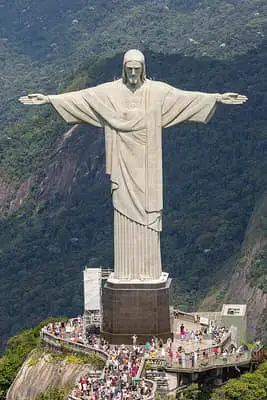
Christ the Redeemer (Cristo Redentor in Portuguese) is a giant statue of Jesus with his arms spread wide, standing on top of Corcovado mountain in Rio de Janeiro, Brazil. The peak is about 700 metres high and lies inside Tijuca National Park, a forest in the middle of the city. The statue looks out over Rio, its beaches and Guanabara Bay.
See it on the 3D globe →At a glance
- Country
- Brazil
- Location
- Rio de Janeiro, Brazil
- Built
- 1931
- Height
- 30 m
- Type
- Statue
Quick answers
Where is Christ the Redeemer?
Christ the Redeemer is in Rio de Janeiro, Brazil.
When was Christ the Redeemer built?
Christ the Redeemer was built in 1931.
How tall is Christ the Redeemer?
Christ the Redeemer is about 30 m tall.
An Art Deco statue of Jesus with outstretched arms, overlooking Rio from the summit of Corcovado.
The statue is 30 metres tall, standing on an 8-metre pedestal, and its arms stretch 28 metres from fingertip to fingertip. It is made of reinforced concrete covered in soapstone and was finished in 1931. It is the largest Art Deco sculpture in the world, a symbol of Rio and of Brazil, and in 2007 it was voted one of the New 7 Wonders of the World.
History
In the 1850s a priest, Pedro Maria Boss, first suggested a Christian monument on Corcovado, but the idea was not approved. In 1920 a Catholic group in Rio tried again and collected donations, mostly from Brazilian Catholics. Several designs were considered, including one of Christ holding a cross and a globe. In the end, the team chose a figure with open arms, as a symbol of peace. The statue opened on 12 October 1931. In 2006 a small chapel was added under the statue, where people can hold baptisms and weddings.
How it was built
Brazilian engineer Heitor da Silva Costa and artist Carlos Oswald designed the statue. French sculptor Paul Landowski made the clay models, and Romanian sculptor Gheorghe Leonida shaped the face. Engineers decided that reinforced concrete, concrete strengthened with steel, would work better than a steel frame for a cross-shaped figure, and French engineer Albert Caquot designed its inner structure. Building took nine years, from 1922 to 1931. Workers carried materials up the mountain on a small cog railway, then covered the concrete with a mosaic of millions of small soapstone tiles, a soft stone that lasts well and is easy to shape.
Looking after it
Standing on a mountaintop, the statue is battered by strong winds and is often hit by lightning. A storm in 2008 damaged its fingers, head and eyebrows, and in 2014 lightning knocked off part of a finger on the right hand. Restorers have cleaned the stone, repaired cracks and fixed the lightning rods. In 2010 they used more than 60,000 pieces of stone from the same quarry as the original. Since 2003, escalators and lifts help visitors reach the platform at the statue's feet.
Fun facts
- Its outstretched arms span 28 m.
- The statue weighs about 635 tonnes.
- At the opening in 1931, the inventor Guglielmo Marconi was supposed to switch on the floodlights by radio from Rome, but bad weather meant they were turned on at the site instead.
- An early design showed Christ holding a globe and a cross instead of spreading his arms.
- Newer replacement stones are a little darker than the originals, because the same pale stone is now hard to find.
On the globe
The model shows the Art Deco statue of Christ with outstretched arms on the summit of Corcovado, overlooking Rio de Janeiro. Zoom in to see the long line of its open arms.
Quiz time
Which is taller: Christ the Redeemer or Rio de Janeiro Cathedral?
Show the answer
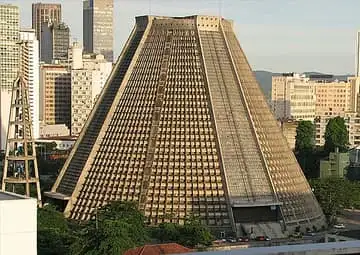
Rio de Janeiro Cathedral. (30 m vs 75 m) Rio de Janeiro Cathedral →
Nearby on the globe





Sources
- Read more on Wikipedia
- Christ the Redeemer (statue) — Wikipedia
- How Was Rio de Janeiro's Christ the Redeemer Statue Built? — TheCollector
- Santuário Cristo Redentor (official sanctuary site)
Updated: 2026-10-13