
Longmen Grottoes
룽먼 석굴
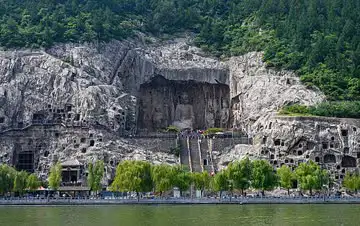
The Longmen Grottoes are a famous group of caves and carved niches in limestone cliffs about 12 kilometres south of Luoyang, in Henan province, China. They hold tens of thousands of Buddhist statues, and they are some of the finest examples of Chinese Buddhist art.
See it on the 3D globe →At a glance
- Country
- China
- Location
- Luoyang, China
- Built
- 493–1127
- Type
- Religious building
Quick answers
Where is Longmen Grottoes?
Longmen Grottoes is in Luoyang, China.
Over 100,000 Buddhist statues carved into limestone cliffs along the Yi River, crowned by the 17 m Vairocana Buddha of Fengxian Temple.
The name means Dragon's Gate Grottoes, because the two hills on either side of the Yi River look like a pair of gate towers. There are as many as 100,000 statues in 2,345 caves, ranging from 25 millimetres to 17 metres in height. UNESCO added the site to its World Heritage List in 2000 for its outstanding artistic creativity.
Who carved them?
Work started in 493, under the Northern Wei dynasty, and went on for centuries. Patrons and donors included emperors, Empress Wu Zetian, royal families, rich families, generals and religious groups. About 30 percent of the caves date from the Northern Wei and 60 percent from the Tang dynasty.
The largest statue, the Vairocana Buddha of Fengxian Temple, was finished in 675 and is about 17 metres tall.
What else is there to see?
Besides statues, the cliffs hold nearly 2,500 stone slabs with writing, which is why the area is called the Forest of Ancient Stelae, and more than sixty Buddhist pagodas. Most of the work was on the west bank of the river, while the smaller caves on the east bank served as homes for monks.
Longmen is one of China's three great grottoes, together with the Yungang Caves near Datong and the Mogao Caves near Dunhuang.
Fun facts
- The caves hold as many as 100,000 statues.
- The tallest statue is about 17 metres, the smallest only 25 millimetres.
- Many of the statues were once painted.
On the globe
The model shows the cliff face with many small carved niches and the big seated Buddha; look for the large central figure.
Nearby on the globe

.jpg)
Sources
Updated: 2026-10-14