
Meteora
메테오라
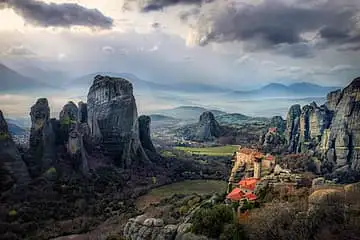
Meteora is a group of enormous rock pillars in Thessaly, northwestern Greece, near the town of Kalambaka. Monasteries sit on top of some of them. The name means "lofty" or "elevated", and is related to the word meteor. The six surviving monasteries became a UNESCO World Heritage Site in 1988, for their outstanding architecture and beauty and their religious and cultural importance.
See it on the 3D globe →At a glance
- Country
- Greece
- Location
- Thessaly, Greece
- Built
- 14th c.
- Height
- 400 m
- Type
- Religious building
Quick answers
Where is Meteora?
Meteora is in Thessaly, Greece.
Monasteries perched on top of towering sandstone pillars, a breathtaking sight.
About 24 monasteries were built on the pillars and rounded boulders, mostly from the second half of the 14th century. Six remain, and four of them are still lived in by monks or nuns and open to visitors: Great Meteoron, Varlaam, Holy Trinity and Saint Stephen. Great Meteoron was established in 1356, and Greeks see Meteora as second in importance only to Mount Athos.
How the rocks were made
The pillars are not volcanic. They are a mix of sandstone and conglomerate, laid down over millions of years by streams flowing into a delta at the edge of a lake.
About 60 million years ago earth movements pushed the seabed upward and made a high plateau with many vertical cracks. Water, wind and extreme temperatures then carved the pillars along those cracks.
Monks on the rocks
In the 800s CE hermit monks moved into hollows and cracks in the rock towers, some up to 550 metres above the plain. They met only on Sundays and special days. Monasteries were built in the 1300s, when monks wanted a safe place to hide from attacks.
Early monks reached the tops with removable ladders and hoisting ropes. Steps were carved into the rock only in the 1920s.
Older than the monasteries
Caves near Meteora were lived in continuously between 50,000 and 5,000 years ago. Theopetra Cave, 4 kilometres from Kalambaka, holds records of two big changes: the replacement of Neanderthals by modern humans, and later the shift from hunting to farming.
A stone wall at its entrance, built 23,000 years ago, is the oldest known built structure. In 1954 an earthquake of magnitude 7 shook the pillars, but they still stand.
Fun facts
- Monks once reached the monasteries by rope ladders and nets.
- Monks once climbed rope ladders and were pulled up in nets.
- Steps were cut into the rock only in the 1920s.
- Six monasteries remain of about 24.
- Theopetra Cave has a wall built 23,000 years ago, probably against cold winds.
On the globe
The model shows monasteries on tall sandstone pillars. Look for the buildings perched on the very top.
Nearby on the globe

Sources
Updated: 2026-10-14