
Pidjiguiti Memorial
피지기티 기념비
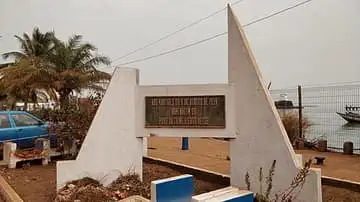
The giant black clenched fist known as the Hand of Timba, honouring the dock workers killed in the 1959 Pidjiguiti strike at Bissau's port, a symbol of the independence struggle.
See it on the 3D globe →At a glance
- Country
- Guinea-Bissau
- Location
- Bissau, Guinea-Bissau
- Built
- after 1974
- Type
- Monument
Quick answers
Where is Pidjiguiti Memorial?
Pidjiguiti Memorial is in Bissau, Guinea-Bissau.
The Pidjiguiti Memorial in Bissau, the capital of Guinea-Bissau, honours dock workers killed at the Pidjiguiti docks on 3 August 1959. The memorial near the docks is a large black clenched fist known as the "Hand of Timba". The day of the event, 3 August, is a public day of remembrance in Guinea-Bissau.
On that day the dock workers went on strike for higher pay. The Portuguese colonial police fired into the crowd and killed at least 25 people, and some accounts say as many as 50. The event is seen as a turning point on the way to independence.
Before the strike
In the 1950s a Portuguese company controlled much of the trade at the docks, and wages and working conditions were poor. A first big strike in 1956 failed, and wages stayed very low.
Even a senior colonial official warned in 1958 that a dock-workers' revolt was likely and advised giving in to the workers' demands, but nothing was done. In late July 1959 the workers met under the palm trees on the quay to plan another strike.
What happened on 3 August
The workers had agreed to stop work at 3 p.m. if their demands for higher pay were not met. When the talks with the manager failed, they put down their tools. The manager summoned the secret police, the PIDE, who arrived about 4 o'clock.
The strikers closed the gates and armed themselves with oars and harpoons, but the police opened fire. Many were killed within minutes, and some who escaped by boat were shot in the water.
Why it matters
The government blamed the independence group PAIGC and arrested several members, though PAIGC had only supported the strike as peaceful resistance. In September 1959 its leader Amílcar Cabral and others decided that peaceful protest in the city would not bring change.
This was the start of the road to the armed struggle that began in 1963 and lasted until 1974, and led to independence. Cabral called the event the massacre of Pijiguiti Quay.
Fun facts
- At least 25 people were killed at the docks on 3 August 1959.
- The workers armed themselves with oars and harpoons.
- The event led the independence movement to take up armed struggle in 1963.
- 3 August is a public day of remembrance in Guinea-Bissau.
On the globe
The model shows the giant black clenched fist, a symbol of the independence struggle.
Nearby on the globe

Sources
Updated: 2026-10-14