
Prague Astronomical Clock
프라하 천문시계
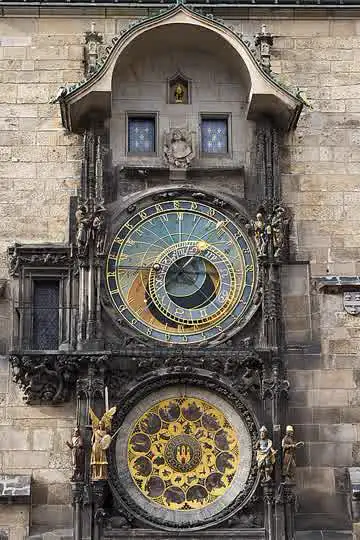
The Prague Astronomical Clock, called the Orloj in Czech, hangs on the south wall of the Old Town Hall tower in Prague, the capital of Czechia. Its oldest parts, the clockwork and the big astronomical dial, were first recorded on 9 October 1410. That makes it the third-oldest astronomical clock in the world and the oldest one that is still working.
See it on the 3D globe →At a glance
- Country
- Czechia
- Location
- Prague, Czechia
- Built
- 1410
- Height
- 69.5 m
- Type
- Tower
Quick answers
Where is Prague Astronomical Clock?
Prague Astronomical Clock is in Prague, Czechia.
When was Prague Astronomical Clock built?
Prague Astronomical Clock was built in 1410.
How tall is Prague Astronomical Clock?
Prague Astronomical Clock is about 69.5 m tall.
A 1410 astronomical clock on the Old Town Hall tower; the Twelve Apostles parade past its windows every hour.
An astronomical clock does more than tell the time. This one also shows where the Sun and Moon are in the sky, the phase of the Moon and the signs of the zodiac. Every hour, crowds gather in Old Town Square to watch a little show: a skeleton rings a bell, and wooden figures of the Twelve Apostles pass by two small windows above the dial. More than 600 years old, it is one of the most famous sights in Prague.
How it works
The main dial is a kind of mechanical astrolabe, an old tool for showing the sky. The blue circle in the middle stands for the sky above the horizon, while the red and black parts stand for dawn, dusk and night. A golden Sun travels around the dial during the day, and a Moon ball that is half silver and half black turns slowly to show the Moon's phase. Below it, a second dial added around 1490 is a calendar with painted pictures for each month.
The hourly show
Four figures stand beside the dial. They stand for things people disliked in the Middle Ages: Vanity looking into a mirror, a Miser holding a bag of gold, Death as a skeleton, and a fourth figure for earthly pleasures. On the hour, the skeleton rings its bell and the others shake their heads, as if saying they are not ready to go. Then the windows above open and the Twelve Apostles appear one after another. A golden crowing rooster joined the show during repairs in the 1860s.
History
The clock was made by the clockmaker Mikuláš of Kadaň together with Jan Šindel, a teacher of mathematics and astronomy at Charles University. For a long time people wrongly believed a clockmaker called Hanuš built it in 1490. A legend says the city councillors had Hanuš blinded so he could never make another clock, but historians found that this story is not true. The clock was badly damaged by fire in May 1945, near the end of World War II, and was repaired and running again by 1948.
Fun facts
- Every hour the Twelve Apostles appear in little windows above the dial.
- The clock is more than 600 years old, and its 600th birthday in 2010 was celebrated with a light show projected onto the tower.
- The Moon on the dial turns using only the pull of a hanging weight, which makes this part of the clock unique in the world.
- The outer ring of the dial shows Old Czech Time, where the day's hours are counted from sunset.
- A local legend says Prague will suffer if the clock is neglected.
- Two of the Apostle figures are Paul and Barnabas, who are not in the usual list of the Twelve.
On the globe
The model shows the Old Town Hall tower in Prague with the astronomical clock on its side. Zoom in to find the round dial where the Apostles appear every hour.
Quiz time
Which is taller: Prague Astronomical Clock or St. Stephen's Cathedral?
Show the answer
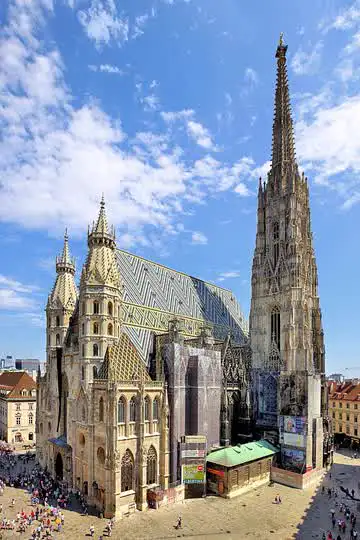
St. Stephen's Cathedral. (69.5 m vs 136 m) St. Stephen's Cathedral →
Nearby on the globe




.jpg)
Sources
- Read more on Wikipedia
- Prague astronomical clock — Wikipedia
- 프라하 천문시계 — 위키백과
- Prague Astronomical Clock — Scientist of the Day, Linda Hall Library
Updated: 2026-10-13