
St. Basil's Cathedral
성 바실리 대성당
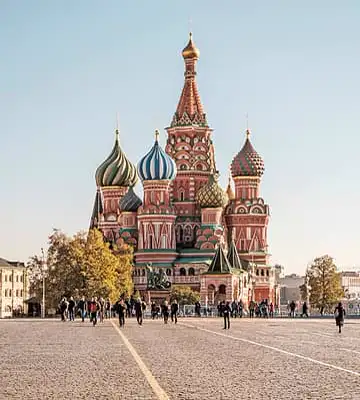
St. Basil's Cathedral is a Russian Orthodox church on Red Square, right next to the Kremlin in the centre of Moscow, Russia. Tsar Ivan IV, better known as Ivan the Terrible, ordered it built between 1555 and 1561 to celebrate his army's capture of the city of Kazan. Its official name is the Cathedral of the Intercession on the Moat, but most people call it after Basil the Blessed, a much-loved local holy man who is buried there.
See it on the 3D globe →At a glance
- Country
- Russia
- Location
- Moscow, Russia
- Built
- 1561
- Height
- 47 m
- Type
- Religious building
Quick answers
Where is St. Basil's Cathedral?
St. Basil's Cathedral is in Moscow, Russia.
When was St. Basil's Cathedral built?
St. Basil's Cathedral was built in 1561.
How tall is St. Basil's Cathedral?
St. Basil's Cathedral is about 47 m tall.
A church on Red Square famous for its cluster of colourful, swirling onion domes.
With its bunch of brightly painted onion domes, the cathedral looks like flames from a bonfire leaping into the sky. Nothing quite like it had been built in Russia before, and today it is one of the best-known pictures of the whole country. Since 1928 it has been part of the State History Museum, and it belongs to the Kremlin and Red Square World Heritage Site.
How it was built
The builders used red brick, which was still a fairly new material in Moscow, on top of white stone foundations. Instead of one big church, they made nine separate chapels on a single base: a tall central chapel with a pointed tent-shaped roof, ringed by eight smaller ones. Each chapel has its own dome. When restorers repaired the walls in the 1950s, they found a hidden wooden frame inside the brickwork that runs the whole height of the church, a full-size model the masons had built around. Nobody knows for sure who the architect was; old records name Barma and Postnik Yakovlev, who may even have been the same person.
Why is it so colourful?
The cathedral was not always this bright. At first the domes and walls were much plainer, mostly showing the red brick. Over more than 150 years, from the 1680s to 1848, painters added stripes, zigzags, swirls and floral patterns as Russian taste turned towards bold colours. In 1683 a band of yellow and blue tiles was added near the top, and a separate bell tower with its own tall tent roof was built beside the chapels. That is why the building looks a little lopsided and why every dome seems to wear a different costume.
History
A tenth chapel was added in 1588 over the grave of Basil the Blessed, and his name slowly became the name of the whole building. Fires damaged it several times, and in the 20th century it came close to being destroyed: in 1933 Soviet planners struck it off the list of protected buildings, and an architect who argued to save it was arrested. By 1937 the plans to knock it down had been dropped. Church services, stopped in 1929, have been held again on a small scale since 1997.
Fun facts
- Ivan the Terrible ordered it built to mark the capture of Kazan.
- A famous legend says Ivan the Terrible blinded the architect so he could never build anything as beautiful again, but historians think this is a myth because the builder kept working on other projects.
- The central chapel is about 46 metres tall inside, yet its floor is only about the size of a large classroom, around 64 square metres.
- Inside, the nine chapels are linked by a maze of narrow, painted corridors, so it is easy to get a little lost.
- The cathedral's wild colours were added over many generations; the last big painting work finished in 1848.
On the globe
The model shows the cathedral's cluster of colourful, swirling onion domes on Red Square in Moscow. Zoom in and try to count the domes and spot how each one has its own pattern.
Quiz time
Which is taller: St. Basil's Cathedral or Moscow Kremlin?
Show the answer
Moscow Kremlin. (47 m vs 80 m) Moscow Kremlin →
Nearby on the globe

Sources
- Read more on Wikipedia
- Saint Basil's Cathedral — Wikipedia
- 성 바실리 대성당 — 위키백과
- St Basil's Cathedral - History and Facts — History Hit
Updated: 2026-10-13