
Sultan Ahmed Mosque (Blue Mosque)
술탄 아흐메트 모스크(블루 모스크)
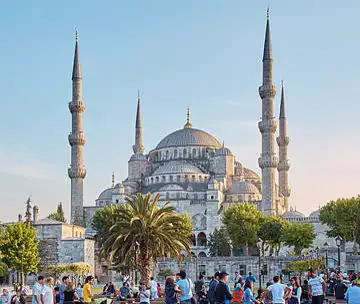
The Sultan Ahmed Mosque, better known as the Blue Mosque, is a large Ottoman mosque in Istanbul, Türkiye. It was built between 1609 and about 1617 for Sultan Ahmed I, who ruled the Ottoman Empire. It stands beside the old Hippodrome, an ancient racetrack, and faces the famous Hagia Sophia across a park.
See it on the 3D globe →At a glance
- Country
- Türkiye
- Location
- Istanbul, Türkiye
- Built
- 1617
- Height
- 64 m
- Type
- Religious building
Quick answers
Where is Sultan Ahmed Mosque (Blue Mosque)?
Sultan Ahmed Mosque (Blue Mosque) is in Istanbul, Türkiye.
When was Sultan Ahmed Mosque (Blue Mosque) built?
Sultan Ahmed Mosque (Blue Mosque) was built in 1617.
How tall is Sultan Ahmed Mosque (Blue Mosque)?
Sultan Ahmed Mosque (Blue Mosque) is about 64 m tall.
Known as the Blue Mosque for its İznik tiles, with six minarets and a cascade of domes.
The mosque gets its nickname from its inside: the walls are covered in thousands of hand-painted tiles and painted flowers, mostly in shades of blue. From outside you see a cascade of domes and six slender towers called minarets. Together with nearby monuments it is part of the UNESCO World Heritage Site "Historic Areas of Istanbul", listed in 1985, and it is still used for prayer today.
History
Sultan Ahmed I wanted a grand mosque to win God's favour after a disappointing peace treaty. Usually, sultans paid for such mosques with treasure won in wars, but Ahmed had no big victories, so he used money from the state treasury. Religious scholars protested, and some even told people not to pray there. The sultan built it anyway, and its beauty won people over. Ahmed I died around the time it was finished and is buried in a tomb beside the mosque. The whole neighbourhood is now called Sultanahmet after it.
How it was built
The architect, Sedefkâr Mehmed Agha, was a student of Mimar Sinan, the most famous Ottoman architect. His nickname Sedefkâr means "worker in mother-of-pearl", the shiny material inside seashells. He placed a central dome 43 metres high on four huge round pillars, surrounded by four half-domes and smaller domes stepping down around them. About 260 windows let daylight into the prayer hall, and a large courtyard stands in front.
What's inside
The lower walls and galleries are covered with 21,043 tiles in more than fifty designs, made in the town of İznik, which was famous for its ceramics. The sultan loved these tiles so much that making them kept the whole İznik tile industry busy while the mosque was being built. Many of the designs show flowers and plants. In the 1800s some of the painted decoration higher up was repainted, which changed some of the original colours.
Fun facts
- Its interior is decorated with more than 20,000 handmade Iznik tiles.
- The inside is decorated with 21,043 İznik tiles in more than fifty different designs.
- Only the sultan was allowed to ride a horse into the courtyard, and a heavy iron chain over the entrance made even him bow his head.
- A legend says the sultan asked for golden minarets (altın) and the architect heard six minarets (altı) instead.
- Seats from the ancient Hippodrome racetrack were dug up in the mosque's courtyard in the early 20th century.
On the globe
The model shows the mosque with its six minarets and a cascade of domes rising to the large central dome. Zoom in and count the minarets around the courtyard and prayer hall.
Quiz time
Which is taller: Sultan Ahmed Mosque (Blue Mosque) or Süleymaniye Mosque?
Show the answer
Süleymaniye Mosque. (64 m vs 76 m) Süleymaniye Mosque →
Nearby on the globe
_(cropped).jpg)
Sources
- Read more on Wikipedia
- Blue Mosque, Istanbul — Wikipedia
- 술탄 아흐메트 모스크 — 위키백과
- The Imperial Ottoman Heritage — GoTürkiye (Turkish Ministry of Culture and Tourism)
Updated: 2026-10-13