
Zaanse Schans windmills
잔세스칸스 풍차
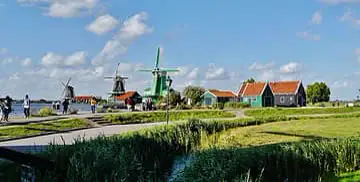
Zaanse Schans is a small village of historic windmills and green wooden houses on the banks of the river Zaan in Zaandam, just north of Amsterdam in the Netherlands. It is part of the town of Zaanstad and only a short train ride from Amsterdam's central station.
See it on the 3D globe →At a glance
- Country
- Netherlands
- Location
- Zaandam, Netherlands
- Built
- 17th–18th c.
- Type
- Historic district
Quick answers
Where is Zaanse Schans windmills?
Zaanse Schans windmills is in Zaandam, Netherlands.
A riverside village of preserved historic windmills and green wooden houses showing Dutch industrial heritage.
The village is a kind of open-air museum. From 1961 to 1974, old houses, workshops and windmills from all over the Zaan region were loaded onto trucks and boats and moved here, so that people could see what this busy area looked like in the past. Long before modern factories, the Zaan region used wind power to saw wood, press oil and grind spices and paint, and it is often called one of the oldest industrial areas in the world. Today millions of visitors come each year to watch the mills turn.
Why there were so many windmills
People along the Zaan built their first windmills around 1600. At first the wind was used to pump water and keep the low, wet land dry. Soon mills were doing all kinds of factory work: sawing timber for ships, pressing oil from seeds, and grinding barley, rice, mustard, tobacco and more. At its peak the district had around a thousand windmills. After about 1850, steam engines took over, and by around 1920 only about twenty mills were left.
What the mills do
Each mill at Zaanse Schans has its own job and name. De Huisman grinds mustard, De Zoeker and De Bonte Hen press oil, and Het Jonge Schaap is a sawmill. De Kat is a paint mill: heavy stone rollers crush dyewood, chalk and coloured stones into fine powder that can be mixed into paint. It is probably the last working paint windmill in the world. A society founded in 1925 still looks after many of the region's mills and keeps them running.
Visiting today
Walking around the village is free, and many of the small shops and workshops can be visited too. Some windmills and the nearby Zaans Museum charge a fee. Inside a working mill you can see how the turning sails drive big wooden gears, which power the grinding stones and saws below. The name Zaanse Schans comes from the river Zaan and from schans, the Dutch word for an earth fort that once stood here during a long war against Spain.
Fun facts
- The Zaan region once had hundreds of working windmills that sawed wood and pressed oil.
- The Zaan district once had around 1,000 windmills working like a giant wind-powered factory.
- De Kat is probably the last paint-making windmill still working anywhere in the world.
- Most of the houses and mills did not start here: they were moved in from other places between 1961 and 1974.
- In a cap-winder mill, only the top cap turns to face the wind, steered by the miller with a big wheel.
On the globe
The model shows a riverside row of preserved windmills and green wooden houses near Amsterdam. Watch for the windmill sails beside the water.
Nearby on the globe


Sources
- Read more on Wikipedia
- Zaanse Schans — Wikipedia
- De Kat paint mill visitor leaflet — Vereniging De Zaansche Molen
Updated: 2026-10-13