
New Zealand sea lion
뉴질랜드바다사자
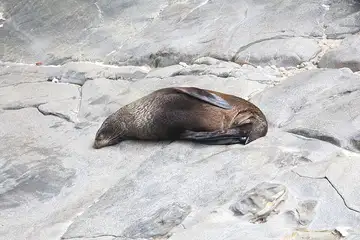
A rare sea lion that breeds mostly on the sub-Antarctic Auckland and Campbell Islands south of New Zealand. Males are dark brown with a thick mane, females are pale buff, and males reach about 2.4 m. It is one of the rarest sea lions.
See it on the 3D globe →At a glance
- Class
- Mammals
- Lives in
- Auckland Islands, south of New Zealand
- Diet
- Meat eater (carnivore)
- Weight
- about 250 kg
- Length
- about 2.4 m
- Conservation status
- Endangered (IUCN EN)
- Habitat
- coasts
Quick answers
Where does the New Zealand sea lion live?
It lives in coasts of the Pacific and Southern oceans. On the globe you can find it near Auckland Islands, south of New Zealand.
How big is the New Zealand sea lion?
It grows to about 2.4 m and 250 kg.
What does the New Zealand sea lion eat?
Its diet: meat eater (carnivore).
Is the New Zealand sea lion endangered?
It is listed as Endangered (IUCN EN).
The New Zealand sea lion (Phocarctos hookeri) is a rare sea lion found only in New Zealand. It was once known as Hooker's sea lion, and in Maori it is called pakake. It breeds mainly on the subantarctic Auckland and Campbell Islands, where about 99 percent of the pups are born, and in recent years it has been slowly breeding again around the coasts of the South Island and Stewart Island.
Fewer than 10,000 animals and fewer than 5,000 breeding adults remain, down from over 15,000 in the early 2000s, and it is one of the world's rarest sea lions. It is the only species in its genus, Phocarctos, and is considered the most threatened sea lion in the world. Males are blackish-brown with a black mane reaching the shoulders, and adult females are buff to creamy grey.
Big males, buff females
Like all eared seals, males and females differ greatly in size. Adult males are 240 to 350 centimetres long and weigh 320 to 450 kilograms, while adult females are 180 to 200 centimetres and 90 to 160 kilograms. Pups are 70 to 100 centimetres long and weigh 8 to 10 kilograms at birth, with a thick dark brown coat.
It is one of the largest animals native to New Zealand. It eats a wide range of prey, including fish, rays, squid, octopus, crustaceans and seabirds, even fur seals. Great white sharks hunt it in turn, and many adults carry scars from near-miss attacks.
Mothers who walk inland
On land, this sea lion behaves differently from other seals and sea lions. In the breeding season, females gradually move inland with their pups to protect them from harassment by males, wind, storms and parasites. They can go up to 2 kilometres from the beach, across tall grass and into forests, and they are the only seal known to travel so far inland.
As mainland numbers have grown since the 1990s, more sea lions have started to enter human spaces.
A comeback and a struggle
Hunting and sealing between the 13th and 19th centuries greatly shrank the species, and sealing was banned by law in 1893. Sea lions were wiped out from mainland New Zealand for more than 150 years, until a female nicknamed Mum gave birth on the Otago Peninsula in 1993. By the 2025 to 2026 breeding season, 38 pups were born in the Otago region.
The main colony at the Auckland Islands fell by about half between 2000 and 2015. Squid trawl nets caught and drowned sea lions in the 1990s, and the government now sets a limit on fishing-related deaths each year.
Fun facts
- It is one of the rarest sea lions in the world, and females sometimes wander into forests far from the sea.
- Its genus Phocarctos has only this one species.
- It is one of the largest animals native to New Zealand.
- It was once called Hooker's sea lion.
- Mothers lead their pups up to 2 km inland, even into forests.
On the globe
The model shows a New Zealand sea lion, a dark male with a thick mane.
Quiz time
Which is heavier: New Zealand sea lion or Hector's dolphin?
Show the answer
New Zealand sea lion. (250 kg vs 50 kg) Hector's dolphin →
More like this

Sources
Updated: 2026-10-14