
Nine-banded armadillo
아홉띠아르마딜로
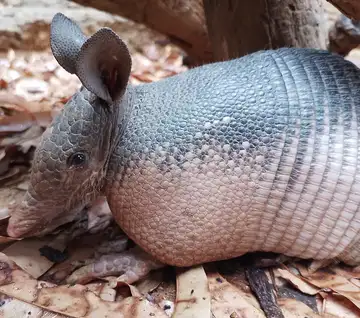
The nine-banded armadillo is a mammal whose shell is made of bony bands, though the actual number of bands varies from seven to eleven. It roots for insects with its long snout and is famous for always giving birth to identical quadruplets. Its range keeps expanding across the southern United States.
See it on the 3D globe →At a glance
- Class
- Mammals
- Lives in
- Southern Texas
- Diet
- Insect eater
- Weight
- about 4.5 kg
- Length
- about 0.8 m
- Lifespan
- up to about 15 years
- Conservation status
- Least Concern (IUCN LC)
- Habitat
- grasslands, forests
Quick answers
Where does the Nine-banded armadillo live?
It lives in grasslands, forests. On the globe you can find it near Southern Texas.
How big is the Nine-banded armadillo?
It grows to about 0.8 m and 4.5 kg.
What does the Nine-banded armadillo eat?
Its diet: insect eater.
How long does the Nine-banded armadillo live?
It can live up to about 15 years.
Is the Nine-banded armadillo endangered?
It is listed as Least Concern (IUCN LC).
The nine-banded armadillo is a mammal wearing armour. Its shell is made of bony plates covered by horny scales and joined by flexible bands of skin, and it covers its back, sides, head, tail and legs. The belly has no armour, just tough skin and coarse hair. Despite the name, the number of bands can vary from seven to eleven.
It lives from rainforest and grassland to dry scrub and mainly hunts ants, termites and other small invertebrates. It is mostly a solitary night-time animal. Adults usually weigh 2.5 to 6.5 kg and are 64 to 107 cm long including the tail, which makes it one of the larger armadillos.
A jumper on the road
If it gets a big fright, the armadillo can jump 91 to 120 cm straight up into the air. That is a danger on roads, because it may jump into the path of a passing car. When chased it can run surprisingly fast, or quickly dig a shallow trench and wedge itself in so that predators cannot pull it out. It has long claws on its middle front toes for digging for food.
Diggers and swimmers
The armadillo digs for beetles, grubs, ants, termites and worms, which its sensitive nose can smell through 20 cm of soil, and licks them up with a sticky tongue. A single animal may keep up to 12 burrows, each as long as 7.6 metres.
Unlike the three-banded armadillos, it cannot roll into a ball. To cross a river it can inflate its intestines and float, or hold its breath for up to six minutes and walk along the bottom.
A spreading species
This species is native to South America, and in Texas and elsewhere in the southern United States its range has kept growing. The Mexican long-nosed armadillo of North America used to be counted as a subspecies.
Mothers nearly always have four identical babies from a single egg, which splits into four embryos. The quadruplets stay in the burrow for about three months, living on milk. A female can produce up to 56 young in her 12 to 15 years of life, which helps explain its fast spread.
Fun facts
- It almost always gives birth to four identical babies that all come from a single egg.
- It can leap about 1 metre straight up when startled.
- It almost always has four identical babies from one egg.
- The number of bands on the shell can be anywhere from seven to eleven.
- It can hold its breath for up to six minutes and walk along a riverbed.
On the globe
The model shows an armadillo with a banded shell and long snout, as in the card. Look at the bands on its back.
Quiz time
Which is heavier: Nine-banded armadillo or American black bear?
Show the answer
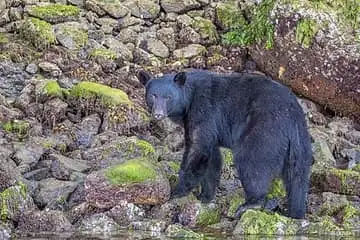
American black bear. (4.5 kg vs 100 kg) American black bear →
More like this



Sources
Updated: 2026-10-14