
Queen Alexandra's birdwing
퀸알렉산드라비단나비
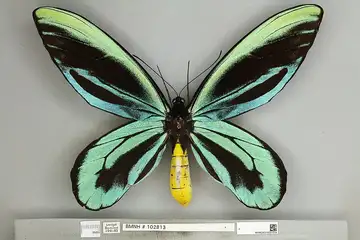
Queen Alexandra's birdwing, from Papua New Guinea, is the largest butterfly in the world, with females spanning more than 25 cm. Males have green and black wings and a yellow abdomen, and the species is endangered.
See it on the 3D globe →At a glance
- Class
- Insects
- Lives in
- Oro Province, Papua New Guinea
- Diet
- Plant eater (herbivore)
- Conservation status
- Endangered (IUCN EN)
- Habitat
- rainforests
Quick answers
Where does the Queen Alexandra's birdwing live?
It lives in rainforests. On the globe you can find it near Oro Province, Papua New Guinea.
What does the Queen Alexandra's birdwing eat?
Its diet: plant eater (herbivore).
Is the Queen Alexandra's birdwing endangered?
It is listed as Endangered (IUCN EN).
Queen Alexandra's birdwing is the largest butterfly in the world. Females can have a wingspan of 25 to 28 centimetres, a body 8 centimetres long and a weight of up to 12 grams, which are huge numbers for a butterfly. It lives only in the forests of Oro Province in eastern Papua New Guinea.
The species is endangered. It is one of only four insects listed on Appendix I of CITES, which makes international trade in it illegal. Males are iridescent bluish green with a black band, and females are brown with white markings. Because it is so rare, it lives in a small area and its forests are shrinking.
How was it discovered?
Albert Stewart Meek, a collector working for Walter Rothschild, found the butterfly in 1906. The next year Rothschild named it after Alexandra of Denmark. The first specimen was taken with the help of a small shotgun, but Meek soon found the caterpillars and raised most of the first specimens himself. The adults feed on flower nectar high in the forest canopy, and the species is protected by law because it is so rare.
Males and females
The two sexes look very different. Females are bigger, with broad rounded brown wings marked with rows of white chevrons and yellow triangles on the hindwings. Males have long, angular wings that shine blue-green, a black stripe down the middle and a yellow-tinged body. The forests of Oro Province are cleared for oil palm plantations, which is a major threat to the butterfly. Its caterpillars feed on a special vine, so protecting that forest plant matters too.
Fun facts
- The world's largest butterfly; females can have wings about 25 cm across.
- Female wingspans can reach 28 centimetres.
- It is one of only four insects on CITES Appendix I.
- It was named after Queen Alexandra of Denmark.
On the globe
The model shows the huge green-and-black butterfly. Look for it over the forests of Papua New Guinea.
More like this

Sources
Updated: 2026-10-14