
Giant weta
자이언트웨타
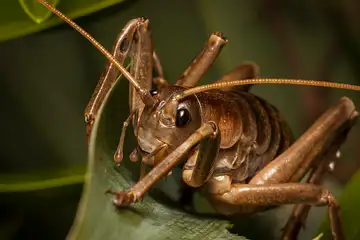
Giant wētā are huge, wingless New Zealand crickets and among the heaviest insects in the world; the heaviest recorded weighed about 70 g. They feed at night on leaves and fruit and kick with their spiny hind legs when threatened.
See it on the 3D globe →At a glance
- Class
- Insects
- Lives in
- New Zealand forests and islands
- Diet
- Plant eater (herbivore)
- Length
- about 0.08 m
- Habitat
- forests
Quick answers
Where does the Giant weta live?
It lives in forests. On the globe you can find it near New Zealand forests and islands.
How big is the Giant weta?
It grows to about 0.08 m.
What does the Giant weta eat?
Its diet: plant eater (herbivore).
Giant wētā are large, wingless insects found only in New Zealand. There are eleven species in the genus Deinacrida, and most are bigger than other wētā. The name means 'terrible grasshopper' in Greek. Large species are up to 7 centimetres long without the legs and antennae, and a typical body mass is no more than 35 grams.
One pregnant captive female reached about 70 grams, which is heavier than a sparrow and one of the heaviest insects ever weighed. That record is unusual, because she was unmated and carried an unusually large number of eggs. The biggest species is the Little Barrier Island giant wētā, called wētāpunga. Giant wētā tend to be less social and more passive than other wētā.
Where do they live?
Most giant wētā now live on offshore islands without introduced mammals such as rats, because those predators nearly wiped them out on the mainland. Three tree-living species are found in the north and are limited to mammal-free habitats. Some species live high in the mountains of the South Island: the scree wētā lives at about 1,200 metres above sea level and can freeze solid when the temperature falls below minus 5 degrees Celsius.
Why are they protected?
All but one giant wētā species are protected by law, because they are at risk of extinction. Their decline is blamed on introduced mammal predators, habitat loss and damage from introduced browsing animals. People have moved some wētā to new, safer places, especially islands where the threats were removed or reduced. Our card says they feed at night on leaves and fruit and kick with their spiny back legs when threatened.
Fun facts
- One captive female weighed about 70 grams, heavier than a sparrow.
- Their genus name means 'terrible grasshopper'.
- The scree wētā can freeze solid and survive.
On the globe
The toy model of the giant wētā sits in the New Zealand forest. Look for the long antennae and spiny back legs.
More like this
_on_leaf.jpg)
Sources
Updated: 2026-10-14