
Algeria: landmarks, animals & facts for kids
1 landmark · 2 animals
Algeria on My Earth Toy, the free 3D toy globe for kids: 1 landmark, 2 animals. Here you can see its flag, capital and size, then fly to every place on the globe.
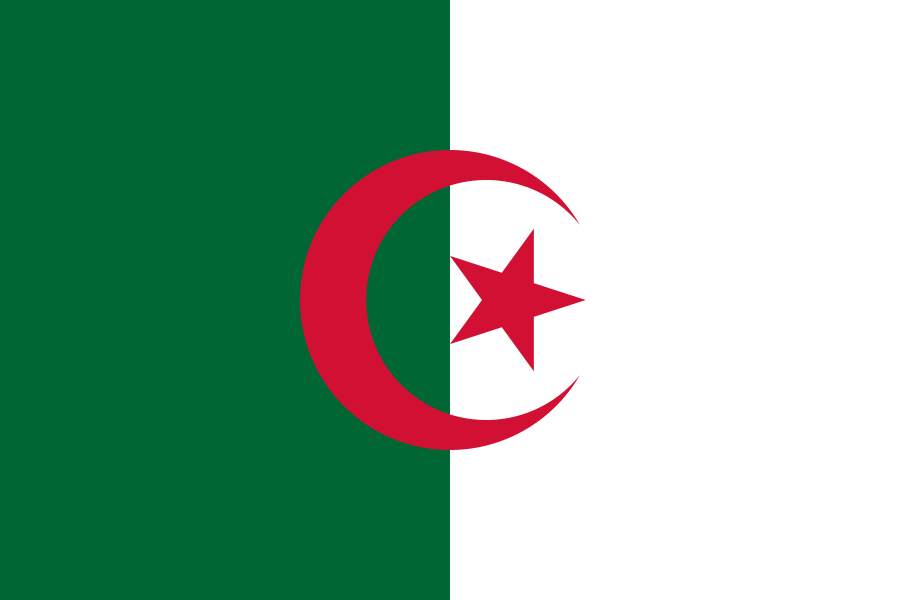
Algeria's flag is split down the middle into green and white halves, with a red crescent and a red five-pointed star in the centre.
Read about this flag →Algeria at a glance
- Capital
- Algiers
- Continent
- Africa
- Area
- 2,381,741 km²
- Population
- 46.8 million
Algeria is the largest country in Africa by area. It lies in North Africa, with a Mediterranean coastline in the north and a huge stretch of the Sahara Desert in the south. Its capital is Algiers, and about 47 million people live there, most of them near the coast. Its name comes from Algiers, the city on the bay.
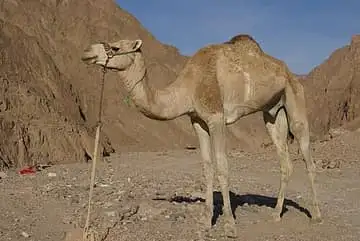
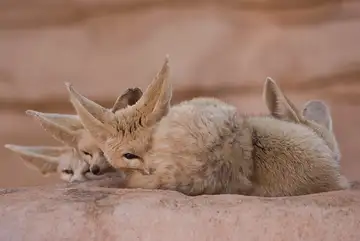
On My Earth Toy you can visit Maqam Echahid, the Martyrs' Memorial in Algiers: three giant concrete palm leaves that rise high above the bay and shelter an eternal flame. You can also meet two desert experts: the dromedary camel and the fennec fox, a tiny fox with enormous ears.
Geography and nature
The Sahara covers more than four-fifths of Algeria. It has sand seas, rocky plateaus and the volcanic Hoggar Mountains. In the southeast, the Tassili n'Ajjer plateau is a maze of rock arches and stone forests. The northern strip near the sea has the Atlas Mountains, green valleys and a mild climate, so most towns and farms are there. The fennec fox, Algeria's national animal, uses its big ears to hear prey under the sand and to let out heat.
People, languages and culture
Most Algerians are of Arab and Amazigh (Berber) heritage. Arabic and Tamazight are the official languages, and French is also widely used. Islam is the main religion. Couscous, steamed grains of semolina served with vegetables and meat, is a favourite meal. Raï, a popular music style, comes from the city of Oran. Football is hugely popular, and the national team is nicknamed the Desert Foxes after the fennec.
History in a nutshell
People have lived in Algeria for a very long time: thousands of rock paintings at Tassili n'Ajjer show animals and herders from when the Sahara was greener. Numidian kingdoms, Romans, Arab dynasties and the Ottoman Empire all ruled here. France took control starting in 1830. After a long war of independence from 1954 to 1962, Algeria became an independent country in 1962. Today oil and natural gas are its most important exports.
Fun facts
- Algeria became Africa's biggest country in 2011, when Sudan split in two.
- Rock art at Tassili n'Ajjer shows giraffes, cattle and swimmers, proof that parts of the Sahara were once wet and green.
- The fennec fox is the smallest fox in the world, but its ears can be about 15 centimetres long.
- The Casbah, the old hilltop town of Algiers, is a UNESCO World Heritage Site.
Famous landmarks in Algeria
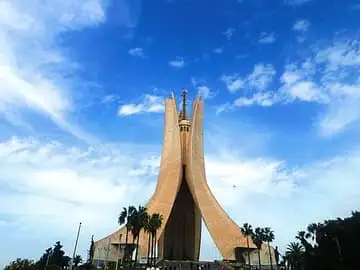
Maqam Echahid (Martyrs' Memorial)
Algeria · Africa
Algiers’ Martyrs’ Memorial, opened in 1982 for the 20th anniversary of independence: three 96 m concrete palm leaves shelter the eternal flame, with a bronze soldier at the foot of each leaf, high above the bay.
Animals in Algeria
Questions
What is the capital of Algeria?
The capital of Algeria is Algiers.
Which continent is Algeria in?
Algeria is in Africa.
How big is Algeria?
Algeria covers about 2,381,741 km².
How many people live in Algeria?
About 46.8 million people live in Algeria.
What are the most famous landmarks in Algeria?
On My Earth Toy's free 3D globe, the landmark from Algeria is Maqam Echahid (Martyrs' Memorial), with a photo and quick facts.
Which animals can you find in Algeria on My Earth Toy?
On the globe you can find Dromedary camel and Fennec fox in Algeria.
Sources
Updated: 2026-10-30