
Fennec fox
페넥여우
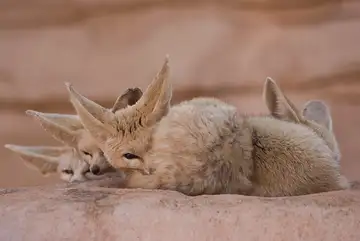
The fennec fox is the smallest fox, weighing only about 1 to 1.5 kg. Its huge ears shed heat and detect prey underground, its pale coat reflects desert sun, and it rests in burrows by day.
See it on the 3D globe →At a glance
- Class
- Mammals
- Lives in
- Sahara Desert and North Africa
- Diet
- Eats both plants and meat (omnivore)
- Weight
- about 1.1 kg
- Length
- about 0.6 m
- Top speed
- about 32 km/h
- Lifespan
- up to about 14 years
- Conservation status
- Least Concern (IUCN LC)
- Habitat
- deserts
Quick answers
Where does the Fennec fox live?
It lives in deserts. On the globe you can find it near Sahara Desert and North Africa.
How big is the Fennec fox?
It grows to about 0.6 m and 1.1 kg.
What does the Fennec fox eat?
Its diet: eats both plants and meat (omnivore).
How fast is the Fennec fox?
It can reach about 32 km/h.
How long does the Fennec fox live?
It can live up to about 14 years.
Is the Fennec fox endangered?
It is listed as Least Concern (IUCN LC).
The fennec fox is the smallest member of the dog family, a small desert fox from North Africa. It lives across the Sahara, from Morocco and Mauritania to northern Sudan, Egypt and the Sinai Peninsula. Its most special feature is its giant ears, which have the greatest ear-to-body ratio of any canid. They help it lose body heat and listen for prey underground.
Its sand-coloured fur reflects sunlight by day and keeps it warm at night, its nose is black, and its tail has a black tip. Furry pads protect its paws on hot sand. Females are 34.5 to 39.5 cm long and weigh 1 to 1.9 kg. Its kidneys are adapted to save water. It eats insects, small rodents, lizards, birds and eggs, and fruit and roots. In the wild it lives about 10 years, and in captivity up to 14.
Dens in the sand
Fennec foxes are mostly active at night, which helps them avoid the Saharan heat and lose less water. They dig dens in the sand. In firm soil a den may cover up to 120 square metres and have up to 15 entrances, and different families sometimes connect their dens. In loose sand the den is simpler, with a single entrance and one chamber. They live in small dunes and wide, treeless sand areas with sparse grasses, sedges and shrubs.
Food and survival
A fennec hunts alone and digs in the sand for small animals and insects. Its prey provides most of its water, and it drinks when it can. Some have been seen burying prey for later. Pups are hunted by owls such as the Pharaoh eagle-owl, and jackals and striped hyenas may attack adults. Nomads say fennecs run so fast and change direction so well that even their Saluki dogs rarely catch one.
Family life
Fennec foxes mate for life. Females have a litter of one to four pups between March and June after 50 to 52 days of pregnancy. The pups open their eyes after 8 to 11 days, and are weaned at 61 to 70 days. The father protects the mother and brings her food, and both parents care for the pups. They communicate with barks, purrs, yaps and squeaks, and young ones are playful. Although not threatened with extinction, they are commonly trapped for sale to tourists or as exotic pets.
Fun facts
- Its huge ears, up to 15 cm long, release body heat and help it hear prey under the sand.
- It has the biggest ears for its size of any dog-family member.
- It is the smallest of all canids.
- Its paw pads are covered in fur.
- It mates for life.
On the globe
The model shows a tiny sandy fox with huge ears, as in the card. Look at the giant ears.
Quiz time
Which is heavier: Fennec fox or Dromedary camel?
Show the answer
Dromedary camel. (1.1 kg vs 460 kg) Dromedary camel →
More like this


Sources
Updated: 2026-10-14