
Eswatini: landmarks, animals & facts for kids
1 landmark
Eswatini on My Earth Toy, the free 3D toy globe for kids: 1 landmark. Here you can see its flag, capital and size, then fly to every place on the globe.
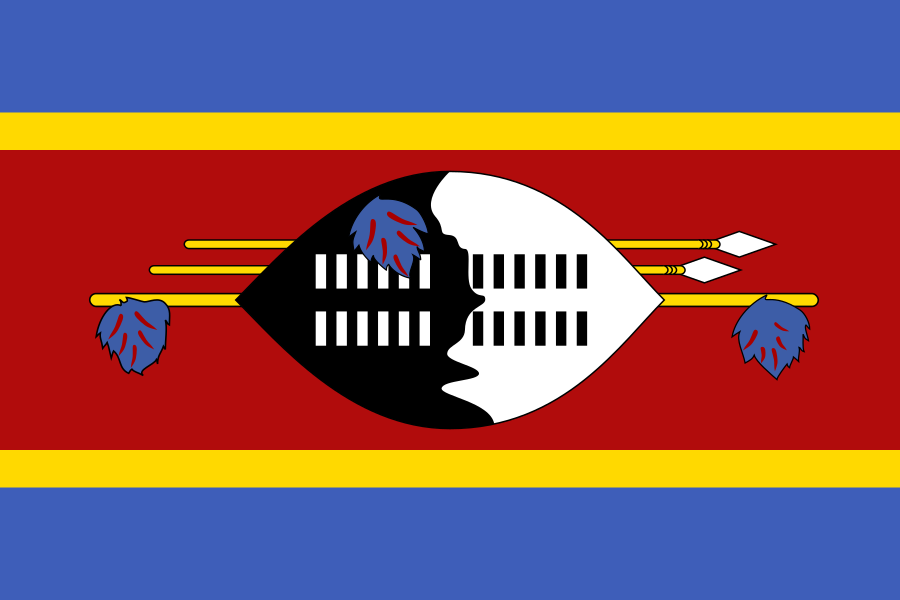
Blue stripes at the top and bottom, a wide crimson stripe edged in yellow in the middle, and a black and white Nguni shield lying sideways across it, with two spears and a feathered staff behind.
Read about this flag →Eswatini at a glance
- Capital
- Mbabane
- Continent
- Africa
- Area
- 17,364 km²
- Population
- 1.2 million
Eswatini, formerly known as Swaziland, is a small landlocked kingdom in southern Africa, surrounded by South Africa on three sides and Mozambique on the east. Mbabane is the executive capital, and Lobamba is the royal and legislative capital. About 1.2 million people live there. Eswatini is one of the world's last absolute monarchies, and it is known for its mountains, wildlife reserves and colourful traditional ceremonies.
On My Earth Toy you can see Sibebe Rock, a giant bare granite dome near Mbabane, often described as one of the largest exposed granite domes in the world. Hikers climb its smooth slopes for wide views over the hills.
Geography and nature
Although Eswatini is tiny, at most about 200 kilometres from north to south, it has four distinct regions. The western highveld is cool and mountainous, with pine forests and granite peaks. The middleveld has rolling hills and farms, and the eastern lowveld is hot bush country where sugar cane grows. The Lubombo Mountains rise on the border with Mozambique. Reserves such as Hlane and Mkhaya protect elephants, lions and rhinos.
People, languages and culture
Most people are Swazi, and siSwati and English are the official languages. Christianity is the main religion, alongside traditional beliefs. Royal ceremonies are central to Swazi life. In the Umhlanga, or Reed Dance, thousands of young women carry tall reeds to the Queen Mother and dance in bright costumes. Incwala is a sacred kingship ceremony held around the summer solstice. Maize porridge is the everyday staple.
History in a nutshell
The Swazi kingdom took shape in the mid-1700s under King Ngwane III and grew under King Mswati II in the 1800s, who gave the people and country their name. Its borders were drawn in 1881. After the Second Boer War it became a British-protected territory, and it regained independence on 6 September 1968. In 2018 the king changed the country's name from Swaziland to Eswatini, meaning 'land of the Swazis'.
Fun facts
- Ngwenya Mine in Eswatini is thought to be the oldest known mine in the world; people dug red iron ore there tens of thousands of years ago.
- Eswatini is the second-smallest country on mainland Africa.
- The Swazi flag shows a black-and-white shield with two spears and a staff.
- Both white and black rhinos are protected in Eswatini's reserves.
Famous landmarks in Eswatini
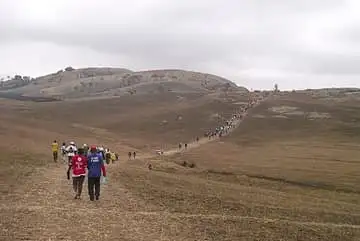
Sibebe Rock
Eswatini · Africa
A giant granite dome rising 350 m above the Mbuluzi valley near Mbabane, one of the largest exposed granite monoliths in the world, nicknamed 'Bald Rock'.
Questions
What is the capital of Eswatini?
The capital of Eswatini is Mbabane.
Which continent is Eswatini in?
Eswatini is in Africa.
How big is Eswatini?
Eswatini covers about 17,364 km².
How many people live in Eswatini?
About 1.2 million people live in Eswatini.
What are the most famous landmarks in Eswatini?
On My Earth Toy's free 3D globe, the landmark from Eswatini is Sibebe Rock, with a photo and quick facts.
Sources
Updated: 2026-10-30