
Flag of Eswatini
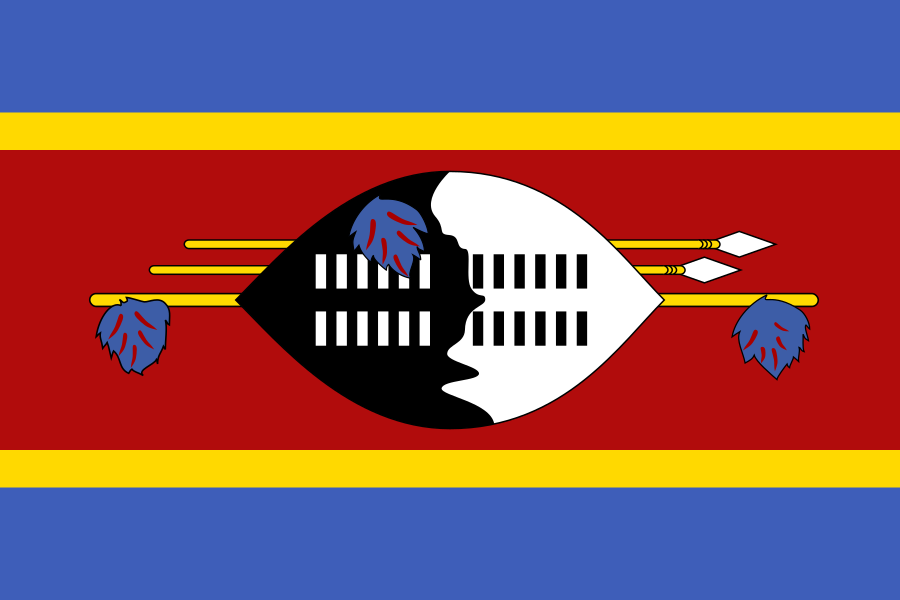
Blue stripes at the top and bottom, a wide crimson stripe edged in yellow in the middle, and a black and white Nguni shield lying sideways across it, with two spears and a feathered staff behind.
At a glance
- Adopted
- October 6, 1968first raised on 25 April 1967 before independence; made the national flag by law in October 1968
- Shape (height : width)
- 2:3
- Capital
- Mbabane
- Continent
- Africa
- Colours
- blue
- yellow
- crimson
- black
- white
What it means
- Crimson: the battles of the past
- Yellow: the country's natural resources and wealth
- Blue: peace and stability
- Shield and spears: protection from enemies
- Black and white shield: said to show black and white people living together in peace
- Feather tassels: made from widowbird and lourie feathers, a decoration kept for the king
Where it came from
The flag was designed by King Sobhuza II. It is based on a military flag he gave to a Swazi regiment (the Swazi Pioneer Corps, or Emasotsha Regiment) in 1941, during the Second World War.
The stripes have fixed sizes: blue 3, yellow 1, crimson 8, yellow 1, blue 3.
History
The flag was first raised on 25 April 1967, when the British Union Flag came down at the end of colonial rule, and it was registered by the College of Arms in London that October. Eswatini (then called Swaziland) became independent in 1968, and the flag was made official on 6 October 1968.
The design has stayed the same since then, though some newer government versions use a lighter blue and show the feather tassels in black or grey.
Fun facts
- The flag was designed by a king, Sobhuza II.
- The shield is a real kind of Nguni warrior shield, drawn lying on its side.
- The feather tassels on the staff are an honour that only the king may wear.
- The flag was raised more than a year before the country became independent.
Questions
What does the flag of Eswatini look like?
Blue stripes at the top and bottom, a wide crimson stripe edged in yellow in the middle, and a black and white Nguni shield lying sideways across it, with two spears and a feathered staff behind.
What do the colours and symbols on the flag of Eswatini mean?
Crimson: the battles of the past; Yellow: the country's natural resources and wealth; Blue: peace and stability; Shield and spears: protection from enemies; Black and white shield: said to show black and white people living together in peace; Feather tassels: made from widowbird and lourie feathers, a decoration kept for the king.
When was the flag of Eswatini adopted?
The current flag of Eswatini was adopted on October 6, 1968. (first raised on 25 April 1967 before independence; made the national flag by law in October 1968)
What colours are on the flag of Eswatini?
The flag of Eswatini uses blue, yellow, crimson, black and white.
Famous landmarks in Eswatini
🎯 Play the flag quiz 🌍 Play the globe
Sources
- en.wikipedia.org
- crwflags.com
- Flag picture: flagcdn.com (Wikimedia Commons)