
Falkland Islands: landmarks, animals & facts for kids
1 landmark
Falkland Islands on My Earth Toy, the free 3D toy globe for kids: 1 landmark. Here you can see its flag, capital and size, then fly to every place on the globe.
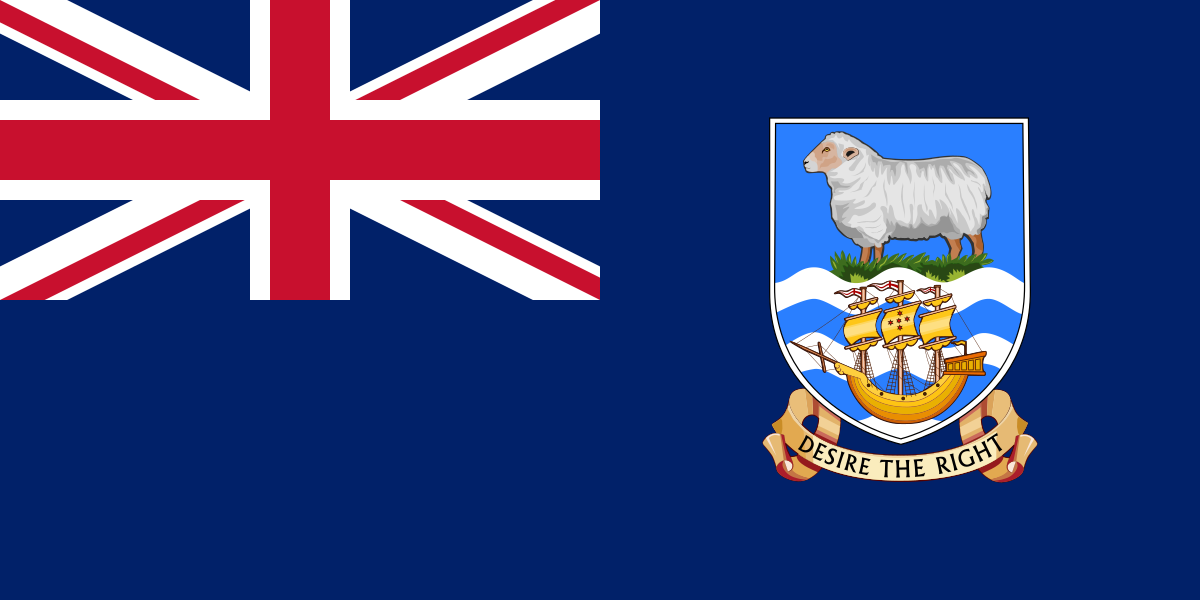
The Falkland Islands flag is dark blue with the British Union Jack in the top corner by the flagpole and the islands' coat of arms, showing a white ram and a sailing ship, on the other side.
Read about this flag →Falkland Islands at a glance
- Capital
- Stanley
- Continent
- South America
- Area
- 12,173 km²
- Population
- 3,500 people
The Falkland Islands are a group of islands in the South Atlantic Ocean, about 500 kilometres east of the southern tip of South America. They are made up of two main islands, East Falkland and West Falkland, and hundreds of smaller ones. The islands are a self-governing British Overseas Territory, and Argentina also claims them under the name Islas Malvinas. The capital is Stanley, and only about 3,500 people live there. The Falklands are known for penguins, seabirds, sheep farms and wide, windy landscapes.
On My Earth Toy you can see Christ Church Cathedral in Stanley, the southernmost Anglican cathedral in the world, with an arch made from the jawbones of blue whales standing in front.
Geography and nature
The islands have rolling hills, rocky ridges called stone runs, peat bogs and white sandy beaches, but almost no native trees. The climate is cool and windy all year, with little difference between summer and winter. The islands are a paradise for wildlife: five kinds of penguins breed here, including king, gentoo, rockhopper and Magellanic penguins, and the Falklands host most of the world's black-browed albatrosses. Elephant seals and sea lions rest on the beaches.
People and life on the islands
English is the main language, and most Falkland Islanders have British ancestry, with some families who have lived on the islands for many generations. Outside Stanley, the countryside is called 'Camp', where people live on large sheep farms. Fishing licences, sheep farming and tourism are the main sources of income. Children on remote farms have sometimes been taught by radio, telephone or travelling teachers.
History in a nutshell
The islands had no known native inhabitants. In the 1700s France, Britain and Spain set up settlements, and later Argentina claimed the islands too. Britain took control in 1833, and they have been governed by Britain since then. In 1982 Argentina invaded the islands, and after a short war Britain regained them in June 1982. Argentina continues to claim sovereignty, while the islanders voted in 2013 to remain a British Overseas Territory.
Fun facts
- The Whalebone Arch outside the cathedral was put up in 1933 to mark 100 years of British rule.
- King penguins can stand nearly a metre tall.
- There are hundreds of thousands of sheep in the Falklands, far more sheep than people.
- Tussac grass on the coasts can grow taller than an adult and gives shelter to birds and seals.
Famous landmarks in Falkland Islands
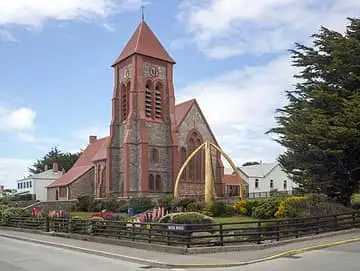
Christ Church Cathedral, Stanley
Falkland Islands · South America
The southernmost Anglican cathedral in the world, with the Whalebone Arch, made from the jawbones of blue whales, standing in front.
Questions
What is the capital of Falkland Islands?
The capital of Falkland Islands is Stanley.
Which continent is Falkland Islands in?
Falkland Islands is in South America.
How big is Falkland Islands?
Falkland Islands covers about 12,173 km².
How many people live in Falkland Islands?
About 3,500 people people live in Falkland Islands.
What are the most famous landmarks in Falkland Islands?
On My Earth Toy's free 3D globe, the landmark from Falkland Islands is Christ Church Cathedral, Stanley, with a photo and quick facts.
Sources
- Falkland Islands — Wikipedia
- Falkland Islands Tourist Board — falklandislands.com
- Falklands Conservation
Updated: 2026-10-30