
Guinea: landmarks, animals & facts for kids
1 landmark
Guinea on My Earth Toy, the free 3D toy globe for kids: 1 landmark. Here you can see its flag, capital and size, then fly to every place on the globe.
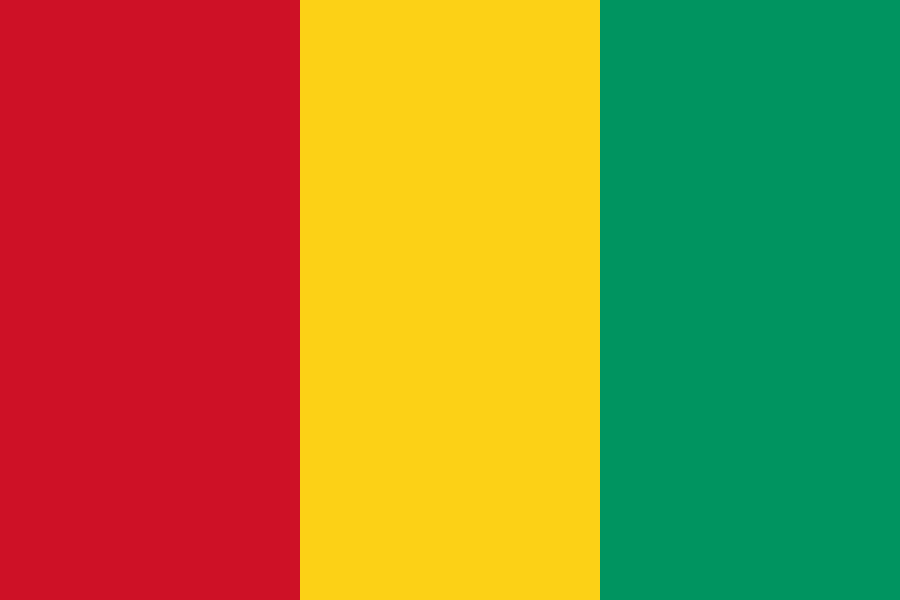
Guinea's flag has three equal vertical stripes: red next to the flagpole, yellow in the middle and green on the outside.
Read about this flag →Guinea at a glance
- Capital
- Conakry
- Continent
- Africa
- Area
- 245,857 km²
- Population
- 14.8 million
Guinea is a country in West Africa on the Atlantic coast, between Guinea-Bissau and Sierra Leone. Its capital, Conakry, is a port city built partly on a narrow peninsula. Guinea is often called the water tower of West Africa, because great rivers such as the Niger, the Senegal and the Gambia begin in its highlands. It also has some of the world's largest deposits of bauxite, the rock used to make aluminium.
On My Earth Toy you can visit the Grand Mosque of Conakry, one of the largest mosques in West Africa, with a golden dome and four tall minarets that stand out over the city.
Geography and nature
Guinea has four main regions: a rainy coast with mangroves, the Fouta Djallon highlands of plateaus and waterfalls, the dry savanna of Upper Guinea, and green forests in the southeast. Mount Nimba, 1,752 metres tall, is the highest point and sits on the border with Côte d'Ivoire; its nature reserve is a UNESCO World Heritage Site. Near the town of Bossou, wild chimpanzees are famous for using stones as hammers to crack open nuts. The rainy season lasts from about June to November.
People, languages and culture
French is the official language, while Pular (Fula), Maninka and Susu are spoken by many people. About 85 percent of Guineans are Muslim, and most of the rest are Christian. Guinea has a rich music tradition played on the djembe drum, the kora harp and the balafon, a wooden xylophone. Griots, storytellers and musicians, keep family histories and old legends alive by singing them from memory.
History in a nutshell
From the 13th century, much of Guinea was part of the great Mali Empire. In the 18th century, Fula Muslims founded a state in the Fouta Djallon. France took control in the 19th century and made Guinea part of French West Africa. In a 1958 referendum, Guinea voted to leave the French community and became independent on 2 October 1958, with Ahmed Sékou Touré as its first president. Since then the country has gone through periods of military rule as well as elections.
Fun facts
- The Niger River, Africa's third-longest, starts in Guinea's highlands not far from the Atlantic, yet flows inland for thousands of kilometres before reaching the sea in Nigeria.
- In the village of Niagassola, a very old balafon called the Sosso Bala is guarded as a treasure and listed by UNESCO.
- Chimpanzees at Bossou crack nuts with a hammer stone on a flat anvil stone.
- Guinea was the first French colony in Africa to vote for independence in 1958.
Famous landmarks in Guinea
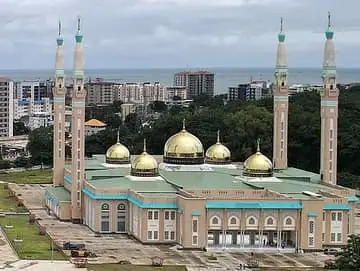
Grand Mosque of Conakry
Guinea · Africa
One of the largest mosques in West Africa, funded by King Fahd of Saudi Arabia, with a golden dome and four tall minarets that dominate Conakry.
Questions
What is the capital of Guinea?
The capital of Guinea is Conakry.
Which continent is Guinea in?
Guinea is in Africa.
How big is Guinea?
Guinea covers about 245,857 km².
How many people live in Guinea?
About 14.8 million people live in Guinea.
What are the most famous landmarks in Guinea?
On My Earth Toy's free 3D globe, the landmark from Guinea is Grand Mosque of Conakry, with a photo and quick facts.
Sources
Updated: 2026-10-30