
Haiti: landmarks, animals & facts for kids
2 landmarks
Haiti on My Earth Toy, the free 3D toy globe for kids: 2 landmarks. Here you can see its flag, capital and size, then fly to every place on the globe.
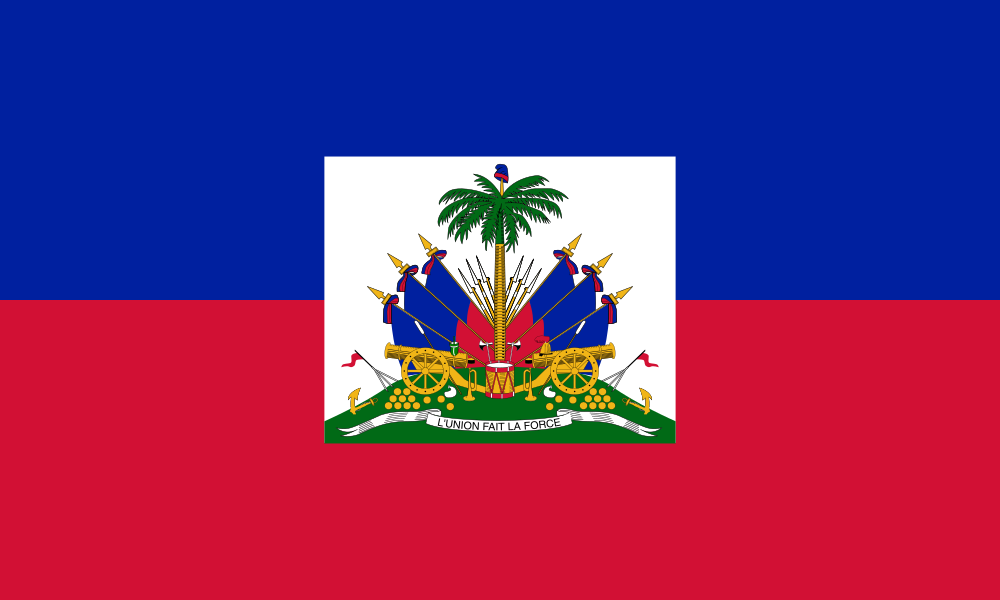
Haiti's flag has a blue stripe over a red stripe, with a white panel in the centre showing the coat of arms: a palm tree topped by a cap of liberty, with weapons and flags below.
Read about this flag →Haiti at a glance
- Capital
- Port-au-Prince
- Continent
- North America
- Area
- 27,750 km²
- Population
- 11.8 million
Haiti is a country in the Caribbean that covers the western third of the island of Hispaniola, which it shares with the Dominican Republic. Its capital is Port-au-Prince. Haiti is the most mountainous country in the Caribbean, and its name comes from a Taíno word often explained as land of high mountains. In 1804 it became the first nation founded by people who had freed themselves from slavery.
On My Earth Toy you can visit the Citadelle Laferrière, the largest fortress in the Americas, built high on a mountain peak to guard against a French return, and the ruins of the nearby Sans-Souci Palace, home of King Henri Christophe. Together they form a UNESCO World Heritage Site.
Geography and nature
Mountains cover much of Haiti, and the highest peak, Pic la Selle, reaches 2,674 metres. Between the ranges lie fertile valleys and plains, and the long coastline has beaches, coral reefs and offshore islands such as La Gonâve and Tortuga. The climate is tropical, and the country can be hit by hurricanes in summer and autumn. Because Haiti sits near the boundary of two tectonic plates, it also experiences earthquakes, such as the very destructive one in 2010.
People, languages and culture
Haiti has two official languages, French and Haitian Creole, and almost everyone speaks Creole at home. Haitian art is famous for its bright colours: painted buses called tap-taps, lively paintings and sculptures cut from recycled metal drums. Kompa is the most popular dance music. Many Haitians are Catholic or Protestant, and Vodou traditions are also part of the culture. On 1 January, Independence Day, families eat soup joumou, a pumpkin soup that celebrates freedom.
History in a nutshell
The Taíno people lived on Hispaniola when Columbus arrived in 1492, but they were almost wiped out under Spanish rule. In 1697 the western part became the French colony of Saint-Domingue, whose sugar and coffee plantations relied on enslaved Africans. A great revolt began in 1791, led at first by Toussaint Louverture, and on 1 January 1804 Jean-Jacques Dessalines declared Haiti independent. Later Haiti was forced to pay France a huge indemnity, and it went through foreign occupation and dictatorship in the 20th century.
Fun facts
- Haiti was the first independent country in Latin America and the Caribbean.
- Soup joumou, Haiti's Independence Day soup, is on UNESCO's list of the world's living heritage.
- The Citadelle was built with walls thick enough to hold cannons and stores to last a long siege.
- Haiti has more people than any other country in the Caribbean.
Famous landmarks in Haiti
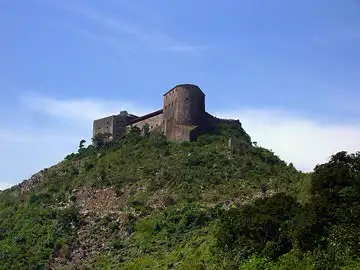
Citadelle Laferrière
Haiti · North America
The largest fortress in the Americas, built on a peak of about 900 m after independence to guard against a French return.
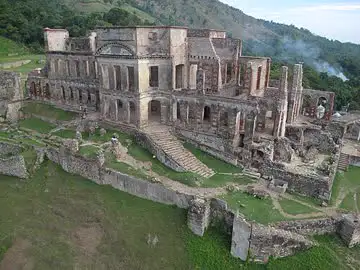
Sans-Souci Palace
Haiti · North America
Ruins of King Henri Christophe's palace; its grand staircase and walls survived the 1842 earthquake.
Questions
What is the capital of Haiti?
The capital of Haiti is Port-au-Prince.
Which continent is Haiti in?
Haiti is in North America.
How big is Haiti?
Haiti covers about 27,750 km².
How many people live in Haiti?
About 11.8 million people live in Haiti.
What are the most famous landmarks in Haiti?
Some of the best-known landmarks in Haiti are Citadelle Laferrière and Sans-Souci Palace. My Earth Toy has 2 landmarks from Haiti on its free 3D globe, each with a photo and quick facts.
Sources
Updated: 2026-10-30