
Lithuania: landmarks, animals & facts for kids
1 landmark
Lithuania on My Earth Toy, the free 3D toy globe for kids: 1 landmark. Here you can see its flag, capital and size, then fly to every place on the globe.
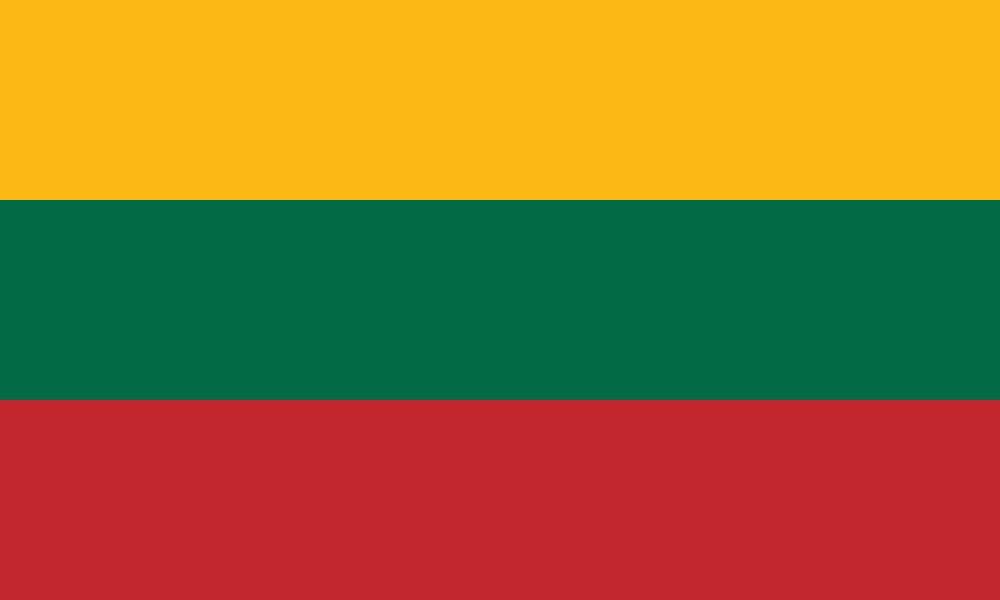
Three equal horizontal stripes of yellow, green and red, from top to bottom.
Read about this flag →Lithuania at a glance
- Capital
- Vilnius
- Continent
- Europe
- Area
- 65,300 km²
- Population
- 2.9 million
Lithuania is a country in northeastern Europe on the Baltic Sea, the largest and southernmost of the three Baltic states. It borders Latvia, Belarus, Poland and the Russian region of Kaliningrad. Its capital is Vilnius, whose old town is full of Baroque churches. Lithuania is known for its forests and lakes, the sand dunes of the Curonian Spit, its very old language and its great love of basketball.
On My Earth Toy you can visit Gediminas' Tower, a red-brick tower on a hill above the old town of Vilnius. It is the last remaining part of the Upper Castle, and the Lithuanian flag flies from its top.
Geography and nature
Lithuania is mostly low plains and gentle hills shaped by ancient glaciers; its highest point, Aukštojas Hill, is only 294 metres tall. Forests cover about a third of the land, and there are thousands of lakes. The Nemunas is the longest river. On the coast, the Curonian Spit is a thin strip of sand nearly 100 kilometres long with some of the highest moving dunes in Europe; Lithuania shares it with Russia. White storks, the national bird, nest in large numbers on farms.
People, languages and culture
Lithuanian is the official language, and Polish and Russian are spoken by minorities. Lithuanian is one of only two living Baltic languages and has kept many very old word forms; linguists study it to learn about the ancient language that many European languages came from. Most people are Roman Catholic. At the Hill of Crosses, visitors have left tens of thousands of crosses. Basketball is almost a national religion, and the Lithuanian team has won Olympic medals.
History in a nutshell
Mindaugas was crowned king of Lithuania in 1253. In the 14th and 15th centuries, the Grand Duchy of Lithuania grew into one of the largest states in Europe, stretching toward the Black Sea. Lithuania joined Poland in a union in 1569. It was taken by the Russian Empire in 1795, declared independence on 16 February 1918, and was occupied by the Soviet Union in 1940. On 11 March 1990 it became the first Soviet republic to declare independence, and it joined the EU and NATO in 2004.
Fun facts
- In 1989, French scientists calculated that the geographical centre of Europe lies just north of Vilnius.
- Lithuania was one of the last countries in Europe to adopt Christianity, in 1387.
- Lithuanian shares some old word forms with Sanskrit, an ancient language of India.
- The Curonian Spit is a UNESCO World Heritage Site shared by Lithuania and Russia.
Famous landmarks in Lithuania
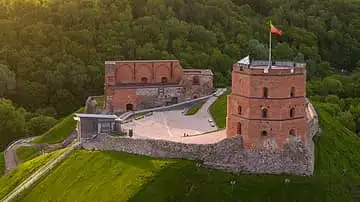
Gediminas' Tower
Lithuania · Europe
The red-brick octagonal tower left of Vilnius's Upper Castle atop Castle Hill, flying the Lithuanian flag as a symbol of the nation.
Questions
What is the capital of Lithuania?
The capital of Lithuania is Vilnius.
Which continent is Lithuania in?
Lithuania is in Europe.
How big is Lithuania?
Lithuania covers about 65,300 km².
How many people live in Lithuania?
About 2.9 million people live in Lithuania.
What are the most famous landmarks in Lithuania?
On My Earth Toy's free 3D globe, the landmark from Lithuania is Gediminas' Tower, with a photo and quick facts.
Sources
Updated: 2026-10-30