
Famous landmarks in Macao SAR China
3 landmarks
Macao SAR China on My Earth Toy, the free 3D toy globe for kids: 3 landmarks. Here you can see its flag, capital and size, then fly to every place on the globe.
Macao SAR China at a glance
- Continent
- Asia
- Area
- 33 km²
- Population
- 0.7 million
Macao (also spelled Macau) is a special administrative region of China on the southern coast, across the Pearl River estuary from Hong Kong. It is made up of the Macao Peninsula and the islands of Taipa and Coloane, which are now joined by land reclaimed from the sea. Macao is one of the most densely populated places in the world. For more than 400 years it was run by Portugal, so it mixes Chinese and Portuguese streets, food and buildings, alongside giant modern resorts.
On My Earth Toy you can see the Ruins of St. Paul's, the stone front of a 17th-century church that still stands after a fire, the 338-metre Macau Tower, and the Grand Lisboa, a golden tower shaped like a lotus flower.
Geography and nature
Macao is tiny, with an area of only about 33 square kilometres, and much of that land was created by filling in the sea. The highest point, Alto de Coloane, is just 172 metres tall. Coloane still has green hills, hiking trails and beaches. The climate is subtropical, with warm, humid summers and cool winters, and typhoons can strike between May and October. Bridges link the peninsula and the islands, and a very long sea bridge connects Macao with Hong Kong and Zhuhai.
People, languages and culture
Chinese and Portuguese are both official languages, but most people speak Cantonese. Street signs are written in both Chinese and Portuguese, and the old town has Portuguese-style squares paved with wavy black-and-white stones next to Chinese temples. The Historic Centre of Macao is a UNESCO World Heritage Site. Macanese food blends Portuguese, Chinese and other flavours, and Macao's egg tarts are famous. Many visitors come for the city's huge entertainment resorts.
History in a nutshell
Portuguese traders began settling in Macao in the 1550s, and it became an important port for trade between China, Japan and Europe. The Church of St. Paul was built in the early 1600s and burned down in 1835, leaving only its front wall. Portugal governed Macao for centuries, and under an agreement with China, it was handed over on 20 December 1999 to become a special administrative region of the People's Republic of China.
Fun facts
- Macao was both the first and the last European colony in China.
- Visitors can bungee jump from the Macau Tower, from a height of 233 metres.
- The Hong Kong–Zhuhai–Macao Bridge, opened in 2018, is about 55 kilometres long, including an undersea tunnel.
- The carved stone front of the Ruins of St. Paul's mixes Christian figures with Asian touches, including Chinese characters and a chrysanthemum flower.
Famous landmarks in Macao SAR China
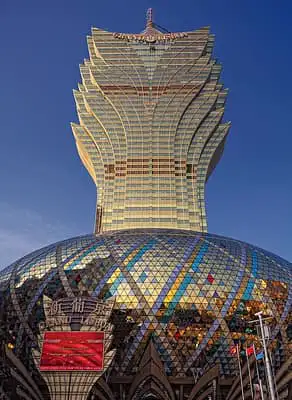
Grand Lisboa
Macao SAR China · Asia
A golden, lotus-shaped casino hotel tower that dominates central Macau.
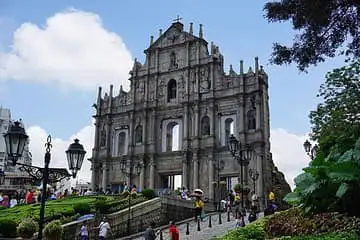
Ruins of St. Paul's
Macao SAR China · Asia
The stone facade surviving from a 17th-century church destroyed by fire, the symbol of Macau.
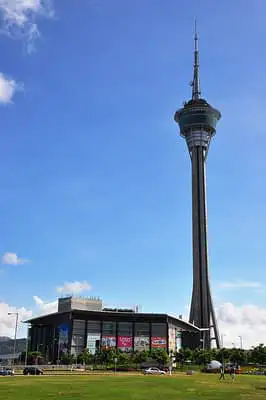
Macau Tower
Macao SAR China · Asia
A 338 m observation tower, home to one of the highest commercial bungee jumps in the world.
Questions
Which continent is Macao SAR China in?
Macao SAR China is in Asia.
How big is Macao SAR China?
Macao SAR China covers about 33 km².
How many people live in Macao SAR China?
About 0.7 million people live in Macao SAR China.
What are the most famous landmarks in Macao SAR China?
Some of the best-known landmarks in Macao SAR China are Grand Lisboa, Ruins of St. Paul's and Macau Tower. My Earth Toy has 3 landmarks from Macao SAR China on its free 3D globe, each with a photo and quick facts.
Sources
Updated: 2026-10-30