
The Maldives: landmarks, animals & facts for kids
1 landmark
The Maldives on My Earth Toy, the free 3D toy globe for kids: 1 landmark. Here you can see its flag, capital and size, then fly to every place on the globe.
the Maldives at a glance
- Capital
- Malé
- Continent
- Asia
- Area
- 300 km²
- Population
- 0.5 million
The Maldives is an island country in the Indian Ocean, southwest of India and Sri Lanka. It is made up of about 1,190 small coral islands grouped into 26 atolls, rings of reef around a lagoon, and only around 200 of the islands are inhabited. Its capital is Malé. The Maldives is the smallest country in Asia and the lowest-lying country in the world, famous for white beaches, turquoise lagoons and colourful coral reefs.
On My Earth Toy you can see the Maldives' famous overwater villas, wooden guest houses built on stilts above a shallow lagoon, connected to the island by long walkways.
Geography and nature
The islands are the tops of coral reefs that grew on an underwater mountain range, so the land is very flat, with an average height of only about 1.5 metres above sea level. This makes the country especially sensitive to rising seas. Under the water, the reefs are full of life: manta rays, whale sharks, turtles, reef sharks and thousands of fish. The climate is warm all year, with a drier northeast monsoon and a rainier southwest monsoon.
People, languages and culture
The national language is Dhivehi, written in a script called Thaana that runs from right to left. English is widely used in schools and business. Islam is the state religion, and nearly all Maldivians are Muslim. Fishing, especially for tuna with poles and lines, is a traditional way of life, and tourism is now the biggest industry. A favourite breakfast is mas huni, tuna mixed with coconut, onion and chilli, eaten with flatbread. Boduberu drumming and dancing are popular at celebrations.
History in a nutshell
People have lived on the islands for well over 2,000 years. Early Maldivians were Buddhist, and in 1153 the islands converted to Islam, beginning centuries of rule by sultans. Sailors and traders knew the Maldives for its cowrie shells, which were used as money across the Indian Ocean. The Portuguese held Malé briefly in the 16th century, and from 1887 the islands were a British protectorate. The Maldives became independent on 26 July 1965 and a republic in 1968.
Fun facts
- Thaana, the Maldivian script, was partly based on Arabic numerals.
- Cowrie shells from the Maldives were once used as money as far away as Africa and China.
- On some Maldivian beaches, tiny glowing plankton make the waves sparkle blue at night.
- In 2009, Maldivian government ministers held a meeting underwater in scuba gear to draw attention to rising sea levels.
Famous landmarks in the Maldives
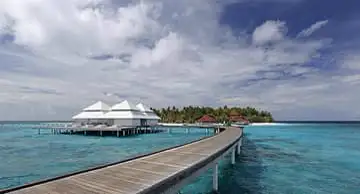
Maldives Overwater Villas
Maldives · Asia
An Indian Ocean island nation famous for overwater villas above turquoise coral lagoons.
Questions
What is the capital of the Maldives?
The capital of the Maldives is Malé.
Which continent is the Maldives in?
The Maldives is in Asia.
How big is the Maldives?
The Maldives covers about 300 km².
How many people live in the Maldives?
About 0.5 million people live in the Maldives.
What are the most famous landmarks in the Maldives?
On My Earth Toy's free 3D globe, the landmark from the Maldives is Maldives Overwater Villas, with a photo and quick facts.
Sources
Updated: 2026-10-30