
North Macedonia: landmarks, animals & facts for kids
1 landmark
North Macedonia on My Earth Toy, the free 3D toy globe for kids: 1 landmark. Here you can see its flag, capital and size, then fly to every place on the globe.
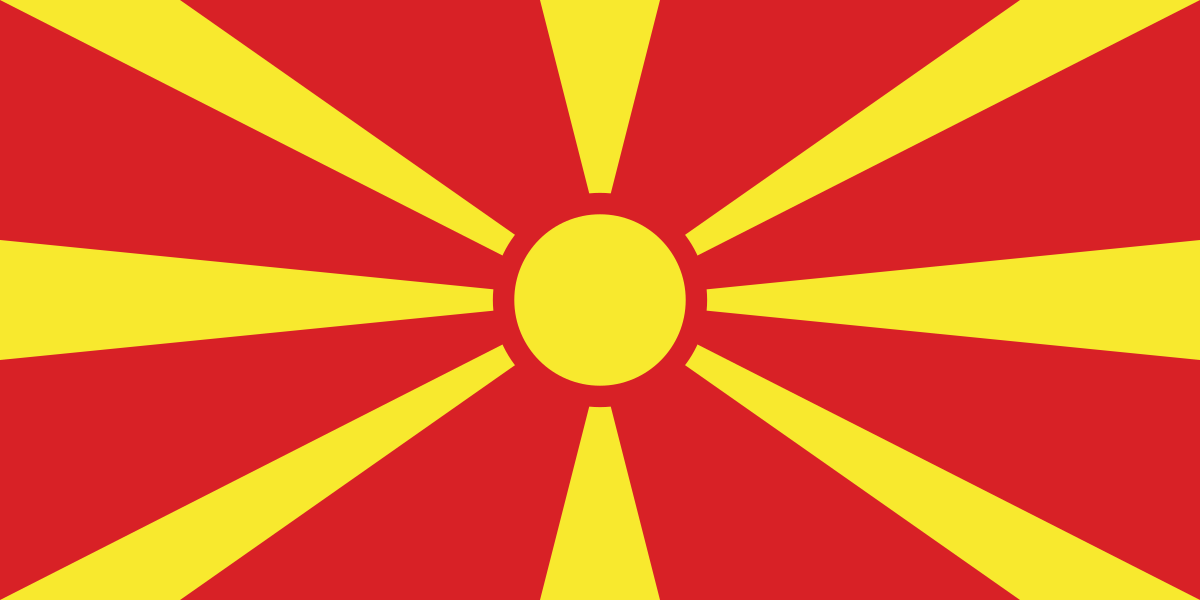
A red flag with a golden-yellow sun in the centre whose eight rays widen as they stretch out to the edges and corners.
Read about this flag →North Macedonia at a glance
- Capital
- Skopje
- Continent
- Europe
- Area
- 25,713 km²
- Population
- 1.8 million
North Macedonia is a small landlocked country in the Balkans in southeastern Europe, bordered by Serbia, Kosovo, Albania, Greece and Bulgaria. Its capital is Skopje. Until 2019 the country was called the Republic of Macedonia; it took its current name under an agreement with Greece. North Macedonia is a land of mountains, deep lakes and old Orthodox churches and monasteries, and it is especially known for Lake Ohrid.
On My Earth Toy you can visit the Church of St. John at Kaneo, a small medieval church standing on a cliff right above the shore of Lake Ohrid, one of the most photographed places in the country.
Geography and nature
Mountains cover much of North Macedonia, with the highest peak, Mount Korab, reaching 2,764 metres on the border with Albania. The Vardar River flows through the middle of the country, past Skopje, toward Greece and the Aegean Sea. In the southwest, Lake Ohrid, shared with Albania, is one of the oldest and deepest lakes in Europe and has many species found nowhere else. Nearby Lake Prespa and national parks such as Mavrovo and Galičica protect bears, lynx and eagles.
People, languages and culture
Macedonian, written in the Cyrillic alphabet, is the main official language, and Albanian is also official; Turkish, Romani and other languages are spoken too. Most people are Orthodox Christians, and about a third are Muslim. Ohrid became an important centre of Slavic learning in the 9th and 10th centuries, when St. Clement and St. Naum taught there. Folk dances in circles, called oro, are performed at weddings and festivals. Tavče gravče, beans baked in a clay pot, is a national dish.
History in a nutshell
In ancient times the region was home to the Paeonians and was partly within the kingdom of Macedon, later becoming part of the Roman and Byzantine empires. In the Middle Ages, Bulgarian and Serbian states ruled here, and then the Ottoman Empire for about five centuries. In the 20th century it became part of Yugoslavia. The country became independent in 1991 and was renamed North Macedonia in 2019. In 1963 a strong earthquake destroyed much of Skopje, which was then rebuilt.
Fun facts
- Lake Ohrid is thought to be more than a million years old.
- Mother Teresa was born in Skopje in 1910.
- Legend says Ohrid once had 365 churches, one for every day of the year.
- The town of Ohrid and its lake are a UNESCO World Heritage Site shared with Albania.
Famous landmarks in North Macedonia
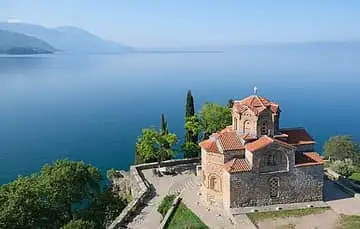
Church of St. John at Kaneo
North Macedonia · Europe
A small 13th-century Byzantine church perched on a cliff above Lake Ohrid; the view of it over the lake is North Macedonia's most famous postcard.
Questions
What is the capital of North Macedonia?
The capital of North Macedonia is Skopje.
Which continent is North Macedonia in?
North Macedonia is in Europe.
How big is North Macedonia?
North Macedonia covers about 25,713 km².
How many people live in North Macedonia?
About 1.8 million people live in North Macedonia.
What are the most famous landmarks in North Macedonia?
On My Earth Toy's free 3D globe, the landmark from North Macedonia is Church of St. John at Kaneo, with a photo and quick facts.
Sources
Updated: 2026-10-30