
Rwanda: landmarks, animals & facts for kids
1 landmark
Rwanda on My Earth Toy, the free 3D toy globe for kids: 1 landmark. Here you can see its flag, capital and size, then fly to every place on the globe.
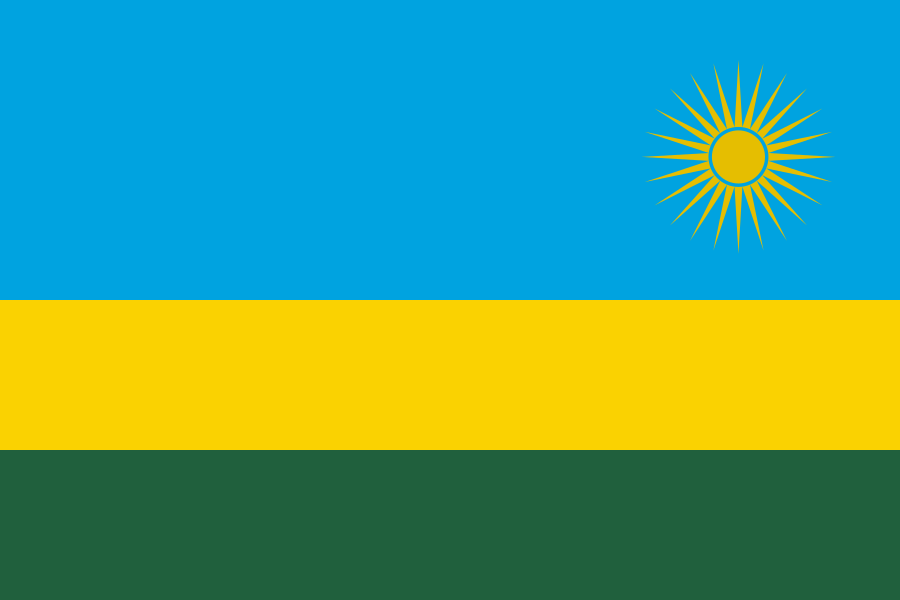
Rwanda's flag has a wide light blue band on top, then thinner yellow and green bands, and a golden sun with 24 rays in the top corner away from the pole.
Read about this flag →Rwanda at a glance
- Capital
- Kigali
- Continent
- Africa
- Area
- 26,338 km²
- Population
- 14.3 million
Rwanda is a small, landlocked country in East-Central Africa, just south of the equator. It borders Uganda, Tanzania, Burundi and the Democratic Republic of the Congo, and its capital is Kigali. Because its land is covered in green, rolling hills, Rwanda is often called the 'land of a thousand hills'.
Rwanda is best known for its rare mountain gorillas, which live in the misty bamboo forests of the Virunga volcanoes. On the globe you can find Volcanoes National Park, where gorilla families roam the slopes of old volcanoes on the border with Uganda and the Democratic Republic of the Congo.
Geography and nature
Rwanda sits high up, and most of it is more than 1,000 metres above sea level, which keeps the climate mild. In the north-west, the Virunga volcanoes rise to Mount Karisimbi, about 4,500 metres tall. Lake Kivu, a large, deep lake, forms much of the western border. Nyungwe Forest in the south-west is an ancient rainforest with chimpanzees and many kinds of monkeys, while Akagera National Park in the east is a savanna where lions, rhinos, elephants and giraffes live. Tea and coffee grow on the hillsides.
People, languages and culture
Almost all Rwandans speak Kinyarwanda, and English, French and Swahili are also official languages. Most people are Christian. Traditional dance is an important art: in the intore dance, performers in grass headdresses leap to the beat of drums. Imigongo is a local art of bold, geometric patterns made with cow dung and painted in black, red and white. On the last Saturday morning of each month, many people join umuganda, a community clean-up and work day.
History in a nutshell
For centuries Rwanda was a kingdom ruled by a king, or mwami. In the late 1800s it became part of German East Africa, and after the First World War Belgium took control. Rwanda became independent on 1 July 1962. In 1994 the country suffered a genocide against the Tutsi, in which hundreds of thousands of people were killed in about 100 days. Since then Rwanda has worked to rebuild, and every year people remember the victims and talk about peace and unity.
Fun facts
- Every year Rwanda holds Kwita Izina, a ceremony where newborn baby gorillas are given names.
- Rwanda banned plastic bags in 2008, and Kigali is known as one of the cleanest cities in Africa.
- Rwanda's parliament has one of the highest shares of women of any parliament in the world.
- The scientist Dian Fossey studied mountain gorillas for years from a camp in the Virunga Mountains of Rwanda.
Famous landmarks in Rwanda
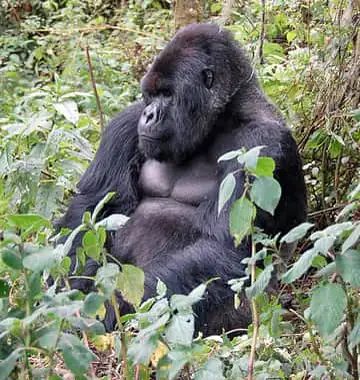
Volcanoes National Park
Rwanda · Africa
Rwanda's park on the forested Virunga volcanoes, home to endangered mountain gorillas that visitors can track on foot.
Questions
What is the capital of Rwanda?
The capital of Rwanda is Kigali.
Which continent is Rwanda in?
Rwanda is in Africa.
How big is Rwanda?
Rwanda covers about 26,338 km².
How many people live in Rwanda?
About 14.3 million people live in Rwanda.
What are the most famous landmarks in Rwanda?
On My Earth Toy's free 3D globe, the landmark from Rwanda is Volcanoes National Park, with a photo and quick facts.
Sources
Updated: 2026-10-30