
Flag of Rwanda
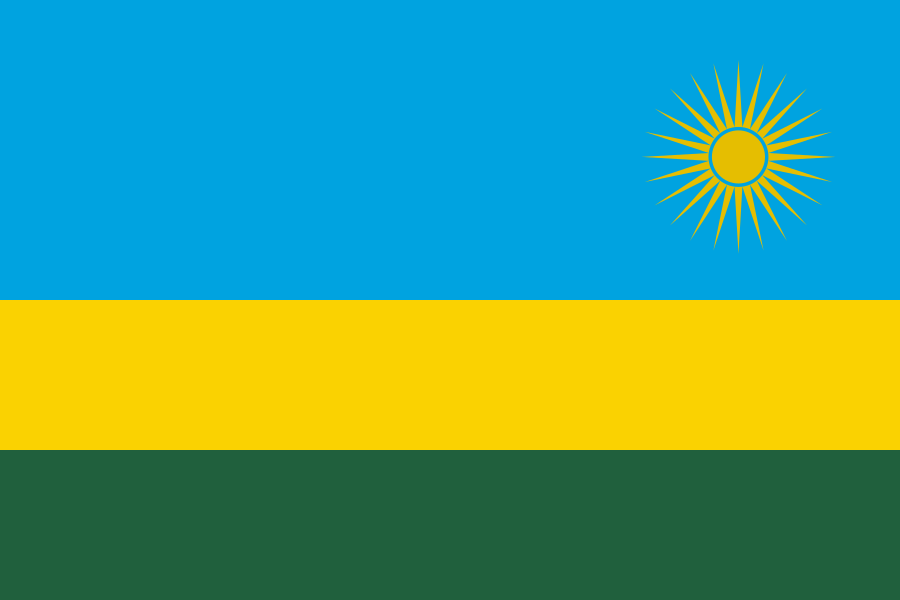
Rwanda's flag has a wide light blue band on top, then thinner yellow and green bands, and a golden sun with 24 rays in the top corner away from the pole.
At a glance
- Adopted
- October 25, 2001approved by parliament on 25 October 2001 and first officially raised on 31 December 2001
- Shape (height : width)
- 2:3
- Capital
- Kigali
- Continent
- Africa
- Colours
- light blue
- yellow
- green
- golden yellow
What it means
- Blue: happiness and peace
- Yellow: economic development
- Green: hope for prosperity
- Sun: enlightenment, national unity, openness and the fight against ignorance
Where it came from
The flag was designed by Alphonse Kirimobenecyo, a Rwandan artist and engineer. His design was chosen in a nationwide contest, and parliament approved the new national symbols on 25 October 2001.
History
Under colonial rule, Rwanda used German and then Belgian flags. At independence it used a red, yellow and green upright tricolour. Because that flag was the same as Guinea's, a black letter R was added in the middle.
After the 1994 genocide, the government said the old flag had become linked to that violence, and many Rwandans felt the red recalled bloodshed. So in 2001 a completely new flag was chosen, meant to show peace, unity and a hopeful future. Some critics saw the change as a political move by the new government.
Fun facts
- The blue band is as wide as the yellow and green bands put together.
- Rwanda's constitution even says the sun is separated from its rays by a blue ring.
- The old Rwandan flag had a big letter R so it would not look like Guinea's.
- The sun sits in the top corner farthest from the pole, not next to it.
- An early report said the flag was 6:13, but that was an embassy mistake; the law says 2:3.
Questions
What does the flag of Rwanda look like?
Rwanda's flag has a wide light blue band on top, then thinner yellow and green bands, and a golden sun with 24 rays in the top corner away from the pole.
What do the colours and symbols on the flag of Rwanda mean?
Blue: happiness and peace; Yellow: economic development; Green: hope for prosperity; Sun: enlightenment, national unity, openness and the fight against ignorance.
When was the flag of Rwanda adopted?
The current flag of Rwanda was adopted on October 25, 2001. (approved by parliament on 25 October 2001 and first officially raised on 31 December 2001)
What colours are on the flag of Rwanda?
The flag of Rwanda uses light blue, yellow, green and golden yellow.
Famous landmarks in Rwanda

🎯 Play the flag quiz 🌍 Play the globe
Sources
- en.wikipedia.org
- crwflags.com
- Flag picture: flagcdn.com (Wikimedia Commons)