
The Seychelles: landmarks, animals & facts for kids
1 landmark
The Seychelles on My Earth Toy, the free 3D toy globe for kids: 1 landmark. Here you can see its flag, capital and size, then fly to every place on the globe.
the Seychelles at a glance
- Capital
- Victoria
- Continent
- Africa
- Area
- 457 km²
- Population
- 0.1 million
Seychelles is an island country in the Indian Ocean, about 1,500 kilometres off the coast of East Africa and north-east of Madagascar. It is made up of 115 islands. The capital, Victoria, on the main island of Mahé, is one of the smallest capital cities in the world, and Seychelles has the fewest people of any African country.
Seychelles is famous for its dreamy beaches, giant granite boulders, turquoise water and rare wildlife such as giant tortoises. On the globe you can find Anse Source d'Argent on the island of La Digue, a beach framed by huge pinkish-grey granite rocks that is one of the most photographed beaches in the world.
Geography and nature
Seychelles has two kinds of islands. The inner islands, such as Mahé, Praslin and La Digue, are made of ancient granite and have steep, forested hills. The outer islands are low coral islands and atolls. Aldabra, a huge coral atoll far to the south-west, is home to over 100,000 Aldabra giant tortoises. On Praslin, the Vallée de Mai forest is where the coco de mer palm grows; its seed is the largest of any plant. Rare birds include the Seychelles black parrot and the magpie-robin.
People, languages and culture
Seychellois people have African, European, Indian and Chinese roots. Seychellois Creole, English and French are the official languages, and most people speak Creole at home. Most people are Catholic. Food is full of fish and spices: grilled fish, octopus curry, and dishes made with coconut and breadfruit are favourites. The moutya is a traditional dance performed around a fire to drumbeats, now listed by UNESCO as cultural heritage. On La Digue, many people still get around by bicycle or ox-cart.
History in a nutshell
Seychelles had no people living on it until the 1700s, though sailors and pirates sometimes stopped by. France claimed the islands and the first settlers arrived in 1770, naming them after a French official, Jean Moreau de Séchelles. Enslaved Africans were brought to work on plantations. Britain took control in 1814, and slavery was ended in the 1830s. Seychelles became independent on 29 June 1976 and is now known for protecting its nature, with about half its land set aside as protected areas.
Fun facts
- A coco de mer seed can weigh around 20 kilograms or more, making it the heaviest seed in the plant world.
- Aldabra Atoll and the Vallée de Mai are both UNESCO World Heritage Sites.
- Victoria's small silver clock tower, called Lorloz, was modelled on a clock in London.
- Some Aldabra giant tortoises can live for well over 100 years.
Famous landmarks in the Seychelles
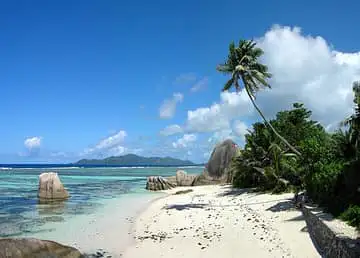
Anse Source d'Argent
Seychelles · Africa
A beach famed for sculpted granite boulders, white sand and shallow turquoise water.
Questions
What is the capital of the Seychelles?
The capital of the Seychelles is Victoria.
Which continent is the Seychelles in?
The Seychelles is in Africa.
How big is the Seychelles?
The Seychelles covers about 457 km².
How many people live in the Seychelles?
About 0.1 million people live in the Seychelles.
What are the most famous landmarks in the Seychelles?
On My Earth Toy's free 3D globe, the landmark from the Seychelles is Anse Source d'Argent, with a photo and quick facts.
Sources
Updated: 2026-10-30