
Slovenia: landmarks, animals & facts for kids
1 landmark
Slovenia on My Earth Toy, the free 3D toy globe for kids: 1 landmark. Here you can see its flag, capital and size, then fly to every place on the globe.
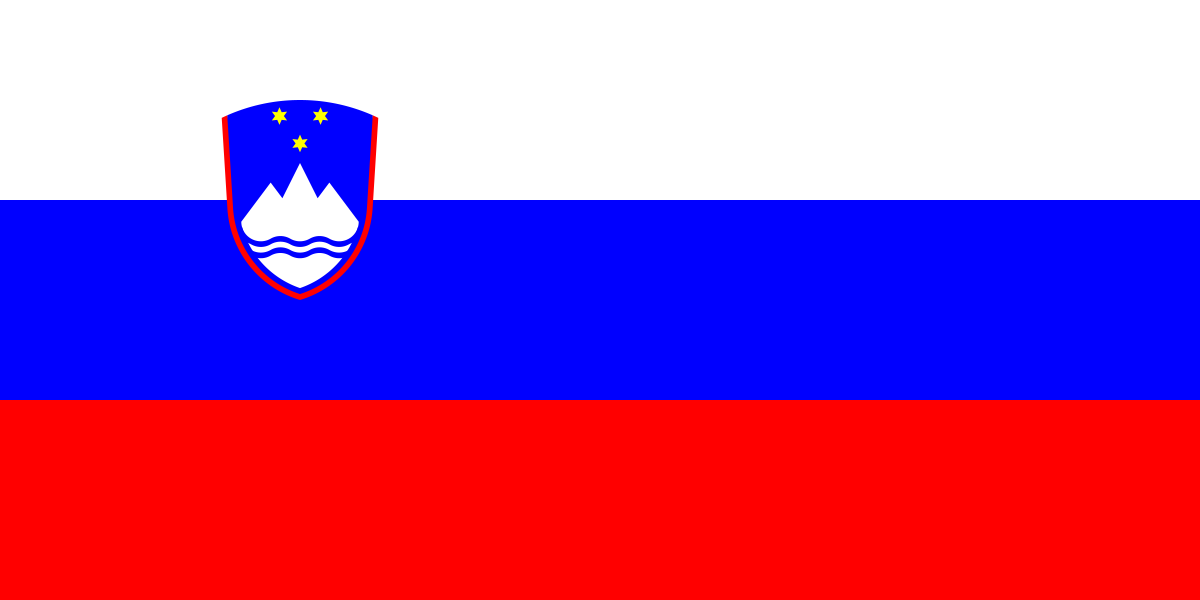
Three horizontal stripes of white, blue and red, with Slovenia's coat of arms near the left, sitting across the white and blue stripes. The shield shows a white mountain, wavy blue lines and three gold stars.
Read about this flag →Slovenia at a glance
- Capital
- Ljubljana
- Continent
- Europe
- Area
- 20,273 km²
- Population
- 2.1 million
Slovenia is a small country in Central Europe where the Alps meet the Mediterranean Sea. It borders Italy, Austria, Hungary and Croatia, and has a short coastline of less than 50 kilometres on the Adriatic Sea. Its capital, Ljubljana, is a friendly green city with a dragon as its symbol.
Slovenia is known for its mountains, forests, caves and fairytale lakes. On the globe you can find Lake Bled, a blue-green Alpine lake with a tiny island and church in the middle and a castle perched on a cliff above the water, one of the most famous views in Europe.
Geography and nature
Northern Slovenia is mountainous, with the Julian Alps and Mount Triglav, at about 2,864 metres the highest peak and a national symbol shown on the flag. More than half of the country is covered in forest, making it one of the greenest countries in Europe, and brown bears roam its woods. In the south-west lies the Karst plateau, which gave its name to a type of limestone landscape full of caves. Postojna Cave and the Škocjan Caves are huge underground worlds, home to the olm, a blind, pale salamander-like amphibian.
People, languages and culture
People speak Slovene, a Slavic language that has a special 'dual' form for talking about exactly two of something. Most Slovenians are Catholic. Beekeeping is a beloved tradition, and painted wooden beehive panels are a famous folk art; Slovenia proposed World Bee Day, now marked each year on 20 May. Hiking and skiing are hugely popular, and many Slovenians try to climb Triglav at least once. Bled cream cake and potica, a rolled nut cake, are favourite treats.
History in a nutshell
Slavic ancestors of the Slovenes settled here in the 500s. For many centuries the region was ruled by the Habsburgs of Austria. After the First World War it became part of the kingdom that later became Yugoslavia, and after the Second World War it was a republic within communist Yugoslavia. Slovenia declared independence on 25 June 1991, followed by a short ten-day war. It joined the European Union in 2004, the first of the former Yugoslav republics to do so.
Fun facts
- The famous white Lipizzaner horses take their name from the stud farm in Lipica, Slovenia, founded in 1580.
- Visitors to Postojna Cave ride a little underground train deep into the cave.
- On Bled Island, visitors climb 99 stone steps to the church and ring its 'wishing bell'.
- The olm can live for about 100 years and survive years without eating.
Famous landmarks in Slovenia
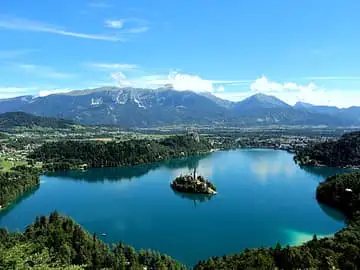
Lake Bled
Slovenia · Europe
An Alpine lake with a tiny church-topped island and a medieval castle perched on a cliff.
Questions
What is the capital of Slovenia?
The capital of Slovenia is Ljubljana.
Which continent is Slovenia in?
Slovenia is in Europe.
How big is Slovenia?
Slovenia covers about 20,273 km².
How many people live in Slovenia?
About 2.1 million people live in Slovenia.
What are the most famous landmarks in Slovenia?
On My Earth Toy's free 3D globe, the landmark from Slovenia is Lake Bled, with a photo and quick facts.
Sources
Updated: 2026-10-30