
South Sudan: landmarks, animals & facts for kids
1 landmark · 1 animal
South Sudan on My Earth Toy, the free 3D toy globe for kids: 1 landmark, 1 animal. Here you can see its flag, capital and size, then fly to every place on the globe.
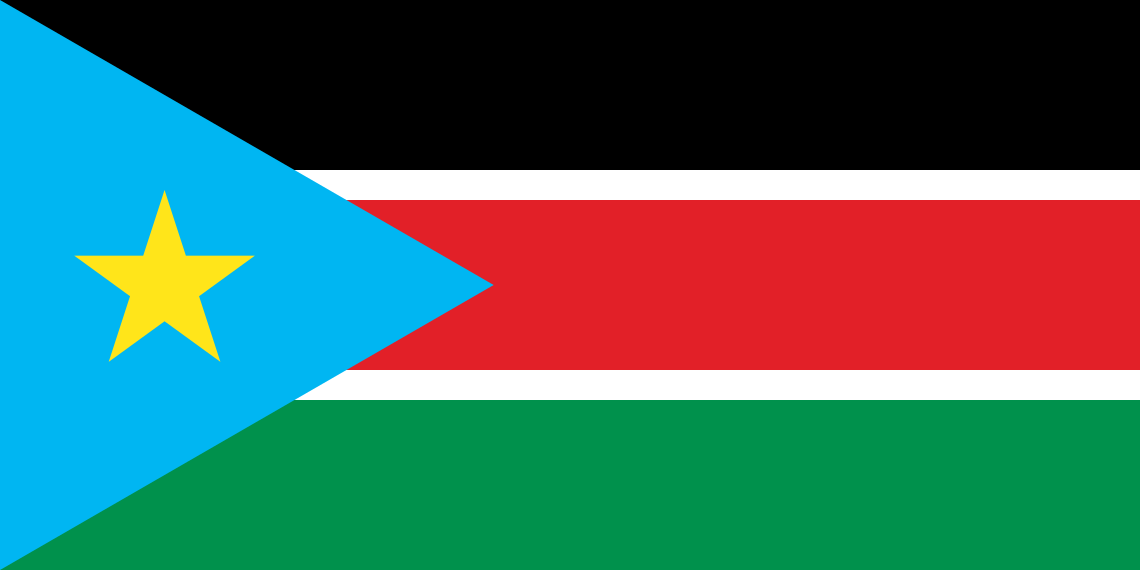
Three horizontal stripes of black, red and green, with thin white lines around the red stripe, and a blue triangle at the left holding a yellow star.
Read about this flag →South Sudan at a glance
- Capital
- Juba
- Continent
- Africa
- Area
- 644,329 km²
- Population
- 11.9 million
South Sudan is a landlocked country in East-Central Africa. It borders Sudan, Ethiopia, Kenya, Uganda, the Democratic Republic of the Congo and the Central African Republic. Its capital is Juba, on the White Nile. South Sudan became independent from Sudan on 9 July 2011, which makes it one of the world's newest countries.
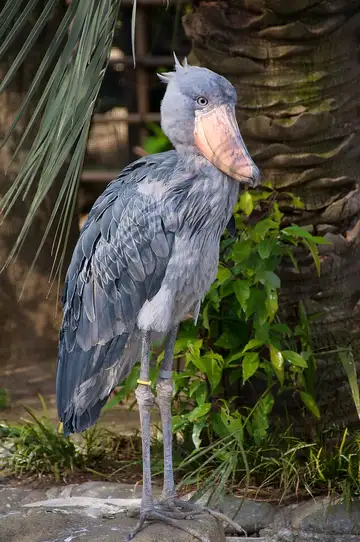
South Sudan is known for the Sudd, one of the largest wetlands in the world, huge animal migrations and its cattle-herding peoples. On the globe you can find the John Garang Mausoleum in Juba, the resting place of a leader of the independence movement, and the shoebill, a giant grey bird with a shoe-shaped bill.
Geography and nature
The White Nile flows north through the middle of South Sudan. In the centre it spreads out into the Sudd, a vast swamp of papyrus, reeds and floating plants that can grow much larger in the rainy season. Around it are grassy plains, while the south has wooded hills and the Imatong Mountains. The country has some of the largest wildlife migrations in Africa, with huge herds of antelopes such as white-eared kob moving across the plains. The rare shoebill hunts lungfish in the swamps.
People, languages and culture
South Sudan is home to more than 60 peoples, including the Dinka, Nuer, Shilluk, Zande and Bari, each with its own language. English is the official language, and many people also use a local form of Arabic called Juba Arabic. Most people are Christian or follow traditional beliefs. For the Dinka and Nuer, cattle are very important: they are a sign of wealth, part of weddings, and the subject of songs. Young people may even take a special 'song ox' name.
History in a nutshell
For centuries many different peoples farmed and herded cattle in this region. In the 1800s it came under Egyptian and then Anglo-Egyptian rule, and in 1956 it became part of the newly independent Sudan. Long civil wars followed, as southern leaders such as John Garang fought for more rights. A peace agreement was signed in 2005, and in a 2011 vote almost everyone chose independence. Since then the young country has faced serious conflict and hardship, and peace agreements have aimed to bring stability.
Fun facts
- South Sudan's flag has a yellow star on a blue triangle, a symbol of the unity of the country.
- The Sudd wetland can cover more than 30,000 square kilometres in the rainy season.
- The shoebill can stand still for hours while waiting to catch a fish.
- In the 2011 vote on independence, almost 99 per cent of voters chose to become a separate country.
Famous landmarks in South Sudan
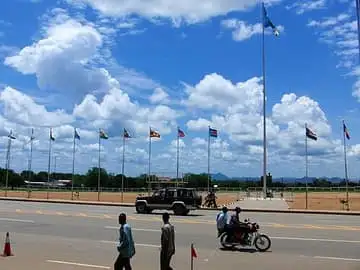
John Garang Mausoleum
South Sudan · Africa
The tomb of John Garang, leader of South Sudan's liberation struggle, on the square in Juba where the country declared independence in 2011.
Animals in South Sudan
Questions
What is the capital of South Sudan?
The capital of South Sudan is Juba.
Which continent is South Sudan in?
South Sudan is in Africa.
How big is South Sudan?
South Sudan covers about 644,329 km².
How many people live in South Sudan?
About 11.9 million people live in South Sudan.
What are the most famous landmarks in South Sudan?
On My Earth Toy's free 3D globe, the landmark from South Sudan is John Garang Mausoleum, with a photo and quick facts.
Which animals can you find in South Sudan on My Earth Toy?
On the globe you can find Shoebill in South Sudan.
Sources
Updated: 2026-10-30