
Shoebill
넓적부리황새
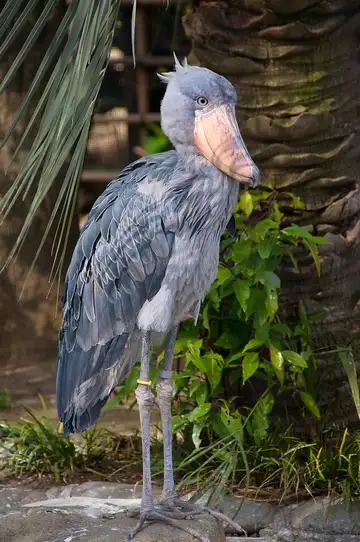
A tall slate-grey wetland bird with a huge clog-shaped bill. It stands almost motionless in shallow swamp water, then lunges at big prey such as lungfish. It is about 1.2 metres tall.
See it on the 3D globe →At a glance
- Class
- Birds
- Lives in
- Sudd wetlands of South Sudan and other swamps of central and eastern Africa
- Diet
- Fish eater
- Weight
- about 5.5 kg
- Length
- about 1.2 m
- Lifespan
- up to about 50 years
- Conservation status
- Vulnerable (IUCN VU)
- Habitat
- wetlands, rivers & lakes
Quick answers
Where does the Shoebill live?
It lives in wetlands, rivers & lakes. On the globe you can find it near Sudd wetlands of South Sudan and other swamps of central and eastern Africa.
How big is the Shoebill?
It grows to about 1.2 m and 5.5 kg.
What does the Shoebill eat?
Its diet: fish eater.
How long does the Shoebill live?
It can live up to about 50 years.
Is the Shoebill endangered?
It is listed as Vulnerable (IUCN VU).
The shoebill (Balaeniceps rex), also called the whale-headed stork, is a large, long-legged wading bird named for its enormous, shoe-shaped bill. It stands 110 to 140 centimetres tall, has a wingspan of 230 to 260 centimetres, and weighs about 4 to 7 kilograms. Adults are mainly grey and young birds are browner. It lives in large swamps of tropical East Africa, from South Sudan down to Zambia.
It was once classified as a stork, but genetic evidence now places it with the pelicans, herons and its closest relative, the hamerkop, in the order Pelecaniformes. Its bill, pinkish with grey markings, has a culmen of about 19 to 24 centimetres. The population is estimated at 5,000 to 8,000 birds, and BirdLife International classifies it as vulnerable because of habitat loss, disturbance and hunting.
Statue of the swamp
Shoebills are known for slow movements and standing still for long periods, which is why people call them statue-like. They often stand on floating plants, and they hunt alone, striding very slowly and often pausing. They use only sight to find prey, and when a target appears they make a quick, violent strike.
After the strike, handling the prey can take more than ten minutes, and about 60 percent of strikes catch something. They like poorly oxygenated water in swamps and bogs where fish come to the surface to breathe. Hippos moving below can push fish up to the surface by accident, which helps the bird.
A solitary family
Unlike herons, pelicans and storks, shoebills nest alone rather than in colonies, and a pair defends a territory of 2 to 4 square kilometres. Both parents build the nest on a floating platform made of water plants after clearing an area about 3 metres across. The female lays one to three white eggs, which hatch after about 30 days.
On hot days, shoebills cool their eggs by filling their bills with water and pouring it over the nest. Both parents brood, shade, guard and feed the chick.
Finding the shoebill
The shoebill may have been known to the ancient Egyptians, but Europeans did not classify it until the 19th century. John Gould briefly described it in 1850 from a skin collected on the upper White Nile by the English traveller Mansfield Parkyns, and he gave a fuller description the next year. He named the genus Balaeniceps from the Latin for whale and head.
Most birds live in swamps in South Sudan, Uganda, eastern Democratic Republic of the Congo and Zambia, with another group in the Malagarasi wetlands of Tanzania. People who live nearby sometimes capture eggs and chicks, and fires and cattle pastures reduce the swamps.
Fun facts
- It can stand almost still for hours waiting for a lungfish to come up for air.
- Its name describes the shoe-shaped bill.
- It is also called the whale-headed stork.
- It clatters its bill instead of singing.
- Europeans first described it in 1850.
On the globe
The toy model shows a shoebill standing in the Sudd wetlands of South Sudan and other East African swamps.
Quiz time
Which is heavier: Shoebill or Grey crowned crane?
Show the answer
Shoebill. (5.5 kg vs 3.5 kg) Grey crowned crane →
More like this

Sources
Updated: 2026-10-14