
St. Helena: landmarks, animals & facts for kids
1 place to discover
St. Helena on My Earth Toy, the free 3D toy globe for kids: 1 place to discover. Here you can see its flag, capital and size, then fly to every place on the globe.
Saint Helena is a small volcanic island in the middle of the South Atlantic Ocean, about 1,900 kilometres west of the coast of southern Africa. It is part of the British Overseas Territory of Saint Helena, Ascension and Tristan da Cunha, three far-apart island groups. Its only town and capital is Jamestown, squeezed into a narrow valley by the sea.
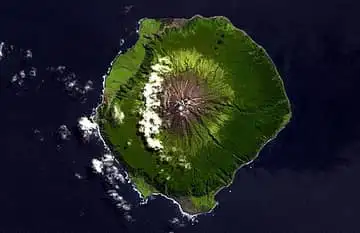
Saint Helena is famous as the island where the French emperor Napoleon was sent to live in exile and died, and as one of the most remote places where people live. On the globe you can find Tristan da Cunha, part of the same territory and often called the most remote inhabited island group in the world.
Geography and nature
Saint Helena rises steeply from the ocean, with dark cliffs around the coast and green, misty hills inside; Diana's Peak, about 820 metres, is the highest point. Many plants and animals live nowhere else, such as the Saint Helena plover, a small bird known locally as the wirebird. Whale sharks gather in the waters around the island. Ascension Island, far to the north-west, is a nesting beach for green turtles, and Tristan da Cunha, far to the south, is a huge volcano with a village at its foot.
People and everyday life
About 4,000 people live on Saint Helena, and they call themselves 'Saints'. They speak English and have roots in Britain, Africa, Asia and other places. Most are Christian. Because the island is so remote, everyone knows each other and many people wave as cars pass. Fishing, especially for tuna, and growing coffee are local industries. On Tristan da Cunha, about 250 people share just a few family names and farm potatoes on small plots.
History in a nutshell
The island was uninhabited when Portuguese sailors found it in 1502. In 1659 the English East India Company settled it as a stop for ships sailing between Europe and Asia, and Jamestown was founded. Enslaved people were brought to work there until slavery ended in the 1830s. Britain sent Napoleon to Saint Helena after his defeat at Waterloo; he lived at Longwood House from 1815 until his death in 1821. For centuries the island could be reached only by ship, until an airport opened in the 2010s.
Fun facts
- Jonathan, a giant tortoise living on Saint Helena, is thought to have hatched around 1832, making him one of the oldest land animals ever recorded.
- Jacob's Ladder, a staircase climbing the hillside above Jamestown, has 699 steps.
- When a volcano erupted on Tristan da Cunha in 1961, all the islanders were taken to England, and most returned two years later.
- Napoleon's tomb was on Saint Helena until his body was taken back to Paris in 1840.
Places to discover in St. Helena
Sources
- Wikipedia: Saint Helena
- Wikipedia: Tristan da Cunha
- CIA World Factbook: Saint Helena, Ascension, and Tristan da Cunha
Updated: 2026-10-30