
St. Kitts & Nevis: landmarks, animals & facts for kids
1 landmark
St. Kitts & Nevis on My Earth Toy, the free 3D toy globe for kids: 1 landmark. Here you can see its flag, capital and size, then fly to every place on the globe.
St. Kitts & Nevis at a glance
- Capital
- Basseterre
- Continent
- North America
- Area
- 261 km²
- Population
- 46,758 people
Saint Kitts and Nevis is a country made of two islands in the eastern Caribbean Sea, in the Leeward Islands of the Lesser Antilles. It is the smallest sovereign country in the Americas, in both area and population. The capital, Basseterre, is on Saint Kitts, the larger island, and the two islands are separated by a channel only about 3 kilometres wide.
Saint Kitts and Nevis is known for its volcanic mountains, beaches, old sugar plantations and colourful carnival. On the globe you can find Brimstone Hill Fortress, a huge stone fortress built on a steep volcanic hill, sometimes called the 'Gibraltar of the West Indies'.
Geography and nature
Both islands are volcanic. On Saint Kitts, the dormant volcano Mount Liamuiga rises to about 1,156 metres, with a crater at its top, and on Nevis the cone of Nevis Peak is often wrapped in cloud. Rainforest covers the upper slopes, while the lower land was once covered in sugar cane fields. The islands are home to many green vervet monkeys, whose ancestors were brought from West Africa centuries ago. Sea turtles nest on the beaches, and coral reefs lie offshore.
People, languages and culture
English is the official language, and many people also speak a local English-based creole. Most people have African ancestry, and most are Christian. The biggest celebration is Sugar Mas, the carnival held over Christmas and New Year, with steel bands, calypso and masquerade dancers in bright costumes. Nevis has its own summer festival, Culturama. The national dish is stewed saltfish served with spicy plantains, coconut dumplings and breadfruit. Cricket and football are popular sports.
History in a nutshell
The Kalinago people called Saint Kitts 'Liamuiga', meaning fertile land. In 1623 the English set up their first colony in the Caribbean here, and the French soon arrived too. Large sugar plantations were worked by enslaved Africans until slavery was abolished in the 1830s. The British built Brimstone Hill Fortress over about a hundred years, and the French captured it in 1782. Saint Kitts and Nevis became independent on 19 September 1983 and is a member of the Commonwealth.
Fun facts
- Alexander Hamilton, one of the founding fathers of the United States, was born on Nevis.
- Brimstone Hill Fortress is a UNESCO World Heritage Site.
- A narrow-gauge railway once used to carry sugar cane now takes visitors on a scenic trip around Saint Kitts.
- The country has only about 48,000 people, the fewest of any country in the Americas.
Famous landmarks in St. Kitts & Nevis
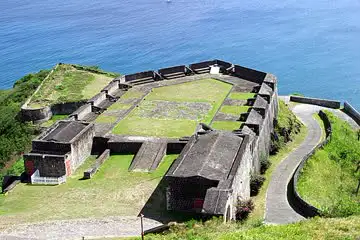
Brimstone Hill Fortress
St. Kitts & Nevis · North America
A British fortress on a volcanic hill overlooking the Caribbean, once called the 'Gibraltar of the West Indies'.
Questions
What is the capital of St. Kitts & Nevis?
The capital of St. Kitts & Nevis is Basseterre.
Which continent is St. Kitts & Nevis in?
St. Kitts & Nevis is in North America.
How big is St. Kitts & Nevis?
St. Kitts & Nevis covers about 261 km².
How many people live in St. Kitts & Nevis?
About 46,758 people people live in St. Kitts & Nevis.
What are the most famous landmarks in St. Kitts & Nevis?
On My Earth Toy's free 3D globe, the landmark from St. Kitts & Nevis is Brimstone Hill Fortress, with a photo and quick facts.
Sources
Updated: 2026-10-30