
Turkmenistan: landmarks, animals & facts for kids
1 landmark
Turkmenistan on My Earth Toy, the free 3D toy globe for kids: 1 landmark. Here you can see its flag, capital and size, then fly to every place on the globe.
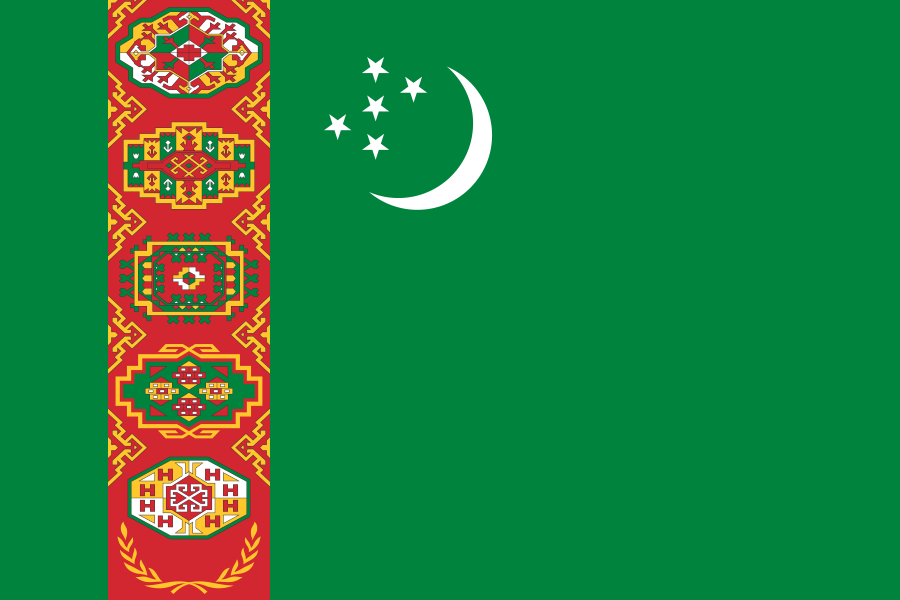
A green flag with a red vertical stripe near the pole holding five carpet patterns above two crossed olive branches, plus a white crescent moon and five white stars in the top corner.
Read about this flag →Turkmenistan at a glance
- Capital
- Ashgabat
- Continent
- Asia
- Area
- 491,210 km²
- Population
- 7.5 million
Turkmenistan is a country in Central Asia. It borders Kazakhstan, Uzbekistan, Afghanistan and Iran, and it has a long coast on the Caspian Sea, the world's largest inland body of water. The capital, Ashgabat, lies near the mountains on the border with Iran and is famous for its gleaming white marble buildings.
Turkmenistan is known for the vast Karakum Desert, beautiful horses and carpets, and huge reserves of natural gas. On the globe you can find the Darvaza gas crater, nicknamed the 'Door to Hell', a giant pit in the desert where natural gas has been burning for decades, glowing brightly at night.
Geography and nature
The Karakum, or 'Black Sand', Desert covers most of Turkmenistan. Along the southern border rise the Kopet Dag mountains, and in the east the great Amu Darya River flows towards the Aral Sea. The Karakum Canal, one of the longest irrigation canals in the world, carries river water across the desert to farms and cities. Summers are very hot and winters can be cold. Desert animals include gazelles, monitor lizards and Asiatic wild asses, called kulan.
People, languages and culture
People speak Turkmen, a Turkic language written in the Latin alphabet, and Russian is also used. Most people are Muslim. Turkmen carpets, woven in deep reds with patterns called güls, are famous, and five carpet patterns appear on the national flag. The Akhal-Teke, a slim horse with a shiny, metallic-looking coat, is a national treasure. Families bake chorek bread in clay ovens and enjoy plov, a rice dish with meat and carrots. Weddings and horse races are big celebrations.
History in a nutshell
Ancient cities such as Merv and Nisa grew up on the Silk Road, and Merv was once one of the biggest cities in the world. Persian, Arab, Turkic and Mongol rulers came and went over the centuries. In the late 1800s the Russian Empire took control, and in 1924 the area became a Soviet republic. Turkmenistan became independent on 27 October 1991. In 1995 the United Nations recognised it as a permanently neutral country.
Fun facts
- Ashgabat holds a world record for having the most buildings covered in white marble.
- Akhal-Teke horses can travel long distances across the desert with little water.
- The ancient city of Merv is a UNESCO World Heritage Site.
- Turkmenistan's flag is one of the most detailed in the world because of its five carpet designs.
Famous landmarks in Turkmenistan
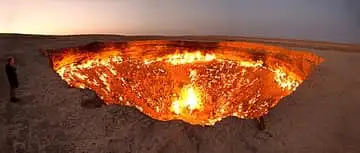
Darvaza gas crater (Door to Hell)
Turkmenistan · Asia
Known as the 'Door to Hell', this roughly 70 m wide pit in the Karakum Desert has been burning natural gas since 1971.
Questions
What is the capital of Turkmenistan?
The capital of Turkmenistan is Ashgabat.
Which continent is Turkmenistan in?
Turkmenistan is in Asia.
How big is Turkmenistan?
Turkmenistan covers about 491,210 km².
How many people live in Turkmenistan?
About 7.5 million people live in Turkmenistan.
What are the most famous landmarks in Turkmenistan?
On My Earth Toy's free 3D globe, the landmark from Turkmenistan is Darvaza gas crater (Door to Hell), with a photo and quick facts.
Sources
Updated: 2026-10-30