
Darvaza gas crater (Door to Hell)
다르바자 가스 분화구
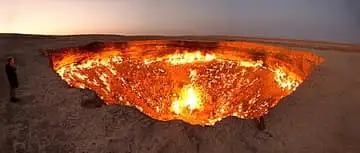
Known as the 'Door to Hell', this roughly 70 m wide pit in the Karakum Desert has been burning natural gas since 1971. At night the glowing crater lights up the empty desert.
See it on the 3D globe →At a glance
- Country
- Turkmenistan
- Location
- Darvaza, Karakum Desert, Turkmenistan
- Built
- 1971 (ignited)
Quick answers
Where is Darvaza gas crater (Door to Hell)?
Darvaza gas crater (Door to Hell) is in Darvaza, Karakum Desert, Turkmenistan.
The Darvaza gas crater, nicknamed the Door to Hell or Gates of Hell, is a big hole in the Karakum Desert of Turkmenistan where natural gas has been burning for decades. It lies near the village of Darvaza, about 260 km north of the capital Ashgabat. The crater is about 60 to 70 metres wide and roughly 30 metres deep, and hundreds of small gas fires light up its floor and rim. Its official name is the Shining of Karakum.
The crater is not a volcano. Sources say that drilling punctured an underground cavern full of natural gas and that the roof of the cavern then collapsed. The gas has burned since 1971 according to many accounts, and some say engineers lit it on purpose to stop poisonous gas from spreading.
How did it start? Nobody is sure
The early story of the crater is still unclear, because records are missing, secret or hard to reach. Some local geologists say a crater collapsed in the 1960s and was set on fire only in the 1980s. Others say Soviet engineers drilled here in 1971 hunting for oil, that the ground fell in within days, and that they chose to burn the gas to stop poisonous fumes, but they badly underestimated how much gas there was. So the exact date and the exact reason are open questions.
Going to the bottom
In 2013 the explorer George Kourounis became the first person to stand at the bottom of the crater. He wore a custom Kevlar harness, was lowered on ropes, and wore an aluminium-coated suit with his own air supply. He was collecting soil samples for the Extreme Microbiome Project, and the trip was backed by National Geographic. Life in such heat seemed impossible, yet the mission was to see what microbes could survive.
Visiting, and a fading fire
The crater is hard to reach. Foreign visitors need a visa for Turkmenistan, and the drive from Ashgabat takes about four hours along a rough road with no signs. Even so it became a major tourist attraction, helped by the area being declared a nature reserve in 2013, and yurts have been set up nearby. The government has talked about putting the fire out because of effects on health, the environment and the gas industry. By 2025 authorities said the fire had been reduced and wells had been drilled around it to capture methane, and infrared images from 2026 show it fading.
Fun facts
- The gas crater has been burning for decades, earning the name 'Door to Hell'.
- The crater's official name, the Shining of Karakum, sounds much gentler than Door to Hell.
- Its fires have been burning since about 1971, though some accounts say the 1980s.
- Another gas crater nearby is fenced off and smells strongly.
- Between 2022 and 2025 the crater gave off an average of about 1,300 kg of methane an hour, according to Carbon Mapper.
On the globe
The model shows the glowing pit of fire in the empty desert.
Nearby on the globe

Sources
Updated: 2026-10-14