
Uganda: landmarks, animals & facts for kids
1 landmark · 1 animal · 1 place to discover
Uganda on My Earth Toy, the free 3D toy globe for kids: 1 landmark, 1 animal, 1 place to discover. Here you can see its flag, capital and size, then fly to every place on the globe.
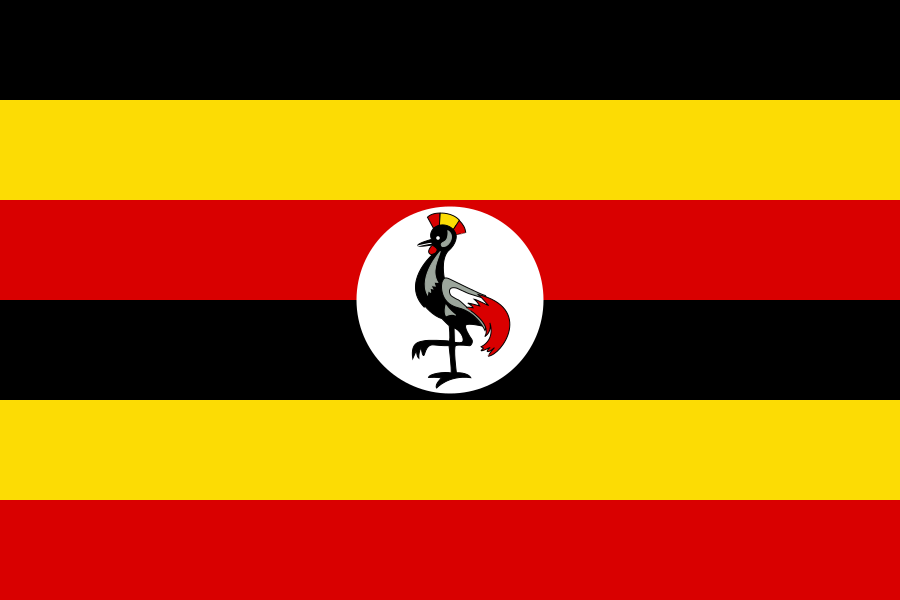
Six horizontal stripes of black, yellow, red, black, yellow and red, with a white circle in the middle showing a grey crowned crane.
Read about this flag →Uganda at a glance
- Capital
- Kampala
- Continent
- Africa
- Area
- 241,038 km²
- Population
- 50 million
Uganda is a landlocked country in East Africa, lying across the equator. It borders Kenya, South Sudan, the Democratic Republic of the Congo, Rwanda and Tanzania, and it shares Lake Victoria, Africa's largest lake, with Kenya and Tanzania. The capital, Kampala, is built on a series of hills near the lake's northern shore.
Uganda is often called the 'Pearl of Africa' for its green landscapes, lakes and wildlife, including mountain gorillas and chimpanzees. On the globe you can find Murchison Falls, where the Nile squeezes through a narrow rocky gap, the source of the Nile at Jinja, and the grey crowned crane, Uganda's national bird.
Geography and nature
Much of Uganda is a high plateau with a pleasant climate, plenty of rain and fertile soil. The Rwenzori Mountains on the western border, called the 'Mountains of the Moon', have glaciers even though they are near the equator; Margherita Peak, about 5,109 metres, is the highest point. The White Nile begins where it flows out of Lake Victoria near Jinja. Bwindi Impenetrable Forest is home to about half of the world's mountain gorillas, and savanna parks shelter lions that climb trees, elephants and hippos.
People, languages and culture
Uganda has more than 40 languages. English and Swahili are official, and Luganda is widely spoken around Kampala. Most Ugandans are Christian, and there is a large Muslim community. A favourite meal is matoke, steamed and mashed green bananas, and a popular street snack is the 'rolex', an omelette rolled in a chapati. Bark cloth, made by beating the inner bark of fig trees, is an ancient craft of the Baganda people listed by UNESCO. Drumming and dance are part of every celebration.
History in a nutshell
Powerful kingdoms such as Buganda, Bunyoro, Ankole and Toro grew up here over centuries. In 1894 Britain made the area a protectorate. Uganda became independent on 9 October 1962. In the 1970s the country went through a period of harsh military rule under Idi Amin, followed by years of unrest. Since the late 1980s it has been more stable, and some of the old kingdoms, including Buganda, have been restored as cultural institutions.
Fun facts
- At Murchison Falls, the Nile forces its way through a gap only about 7 metres wide and drops about 43 metres.
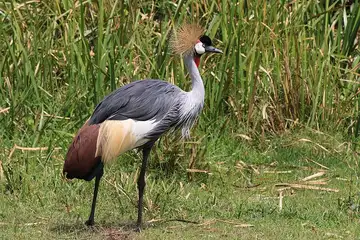
- The grey crowned crane, with its golden crest, appears in the centre of Uganda's flag.
- The equator crosses Uganda, and there are monuments where you can stand with one foot in each hemisphere.
- Lake Victoria is the largest lake in Africa and the largest tropical lake in the world.
Famous landmarks in Uganda
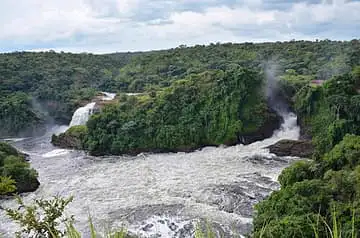
Murchison Falls
Uganda · Africa
Here the entire Nile forces itself through a 7-metre gap in the rock, making a thunderous waterfall.
Animals in Uganda
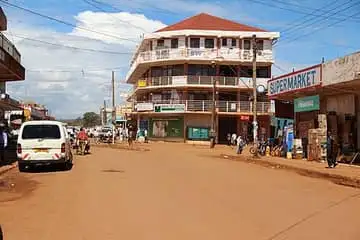
Places to discover in Uganda
Questions
What is the capital of Uganda?
The capital of Uganda is Kampala.
Which continent is Uganda in?
Uganda is in Africa.
How big is Uganda?
Uganda covers about 241,038 km².
How many people live in Uganda?
About 50 million people live in Uganda.
What are the most famous landmarks in Uganda?
On My Earth Toy's free 3D globe, the landmark from Uganda is Murchison Falls, with a photo and quick facts.
Which animals can you find in Uganda on My Earth Toy?
On the globe you can find Grey crowned crane in Uganda.
Sources
Updated: 2026-10-30