
Grey crowned crane
회색관두루미
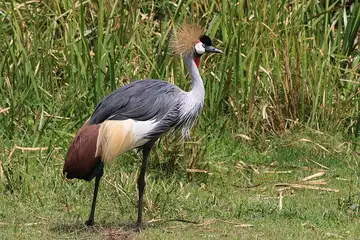
A crane with a spray of stiff golden feathers on its head, white cheeks and a red throat wattle. It is the national bird of Uganda, and unlike most cranes it can roost in trees.
See it on the 3D globe →At a glance
- Class
- Birds
- Lives in
- Wetlands and grasslands of East Africa, such as Uganda and Kenya
- Diet
- Eats both plants and meat (omnivore)
- Weight
- about 3.5 kg
- Conservation status
- Endangered (IUCN EN)
- Habitat
- wetlands, grasslands, savannas
Quick answers
Where does the Grey crowned crane live?
It lives in wetlands, grasslands, savannas. On the globe you can find it near Wetlands and grasslands of East Africa, such as Uganda and Kenya.
How big is the Grey crowned crane?
It grows to about 3.5 kg.
What does the Grey crowned crane eat?
Its diet: eats both plants and meat (omnivore).
Is the Grey crowned crane endangered?
It is listed as Endangered (IUCN EN).
The grey crowned crane is a tall African crane, about one metre high, with a two-metre wingspan. Its body is mostly grey, its wings are white, dark and golden, and on its head it wears a crown of stiff golden feathers. It has white cheeks and a bright red throat pouch that it can inflate.
It lives in the grasslands, wetlands and farmland of East and southern Africa. It is the national bird of Uganda and appears on the country's flag. Wildlife groups worry about it, and the IUCN lists it as Endangered. The scientific name Balearica regulorum separates it from the black crowned crane, a close relative of West Africa.
A crane that perches in trees
Most cranes cannot grip branches. The grey crowned crane has a long back toe that lets it hold on, so it can roost in trees at night.
It feeds on the ground and eats almost anything: seeds, grain, insects, frogs, worms, small snakes and fish. Its feet are large and slender, which helps with balance. It also lives near rivers and lakes, and in fields that people farm.
Danger from drained wetlands
The cranes need wet grassland and marshes to nest. When wetlands are drained for farming or built over, the cranes lose their homes.
There are two subspecies: the East African one, which has more bare red skin on the face, and the smaller South African one. Young cranes are greyer than adults and have feathered, tan faces. Protecting wet grassland helps cranes and many other animals that need it.
Fun facts
- It is the national bird of Uganda and appears on the country's flag.
- It is the national bird of Uganda and is on the Ugandan flag.
- It can sit in trees, which most cranes cannot.
- Its golden crown is made of stiff feathers.
On the globe
The globe places the grey crowned crane in the wetlands and grasslands of East Africa, such as Uganda and Kenya. Look for the golden crown.
Quiz time
Which is heavier: Grey crowned crane or Vulturine guineafowl?
Show the answer
Grey crowned crane. (3.5 kg vs 1.3 kg) Vulturine guineafowl →
More like this
.jpg)
Sources
Updated: 2026-10-14