
Atlantis (legend)
아틀란티스 전설
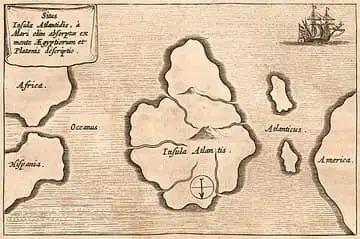
Atlantis is the legendary island kingdom described by the Greek philosopher Plato around 360 BC, said to lie in the ocean beyond the "Pillars of Hercules" (the Strait of Gibraltar). Its capital was built as rings of land and water around a central island with a temple of Poseidon, and it sank into the sea "in a single day and night". Most historians think Plato made it up, though some link it to the great eruption of Santorini.
See it on the 3D globe →At a glance
- Kind
- Legendary creatures
Atlantis is a legendary island that first appears in two books by the Greek philosopher Plato, Timaeus and Critias, written around 360 BC. He described a mighty naval power that tried to conquer much of the known world, lost the favour of the gods, and sank into the sea in a single terrible day and night.
Today, scholars of ancient Greece agree that Plato invented the story to make a point about pride and about the best kind of state. No trace of a real Atlantis has ever been found. Still, the idea of a lost, advanced island has inspired writers, filmmakers and treasure hunters for more than two thousand years, and the name has become a byword for any lost civilisation.
What Plato said
Plato placed Atlantis beyond the Pillars of Heracles, which means beyond the Strait of Gibraltar, and said it existed more than 9,000 years before his time. He wrote that the island was larger than Libya and Asia together. The god Poseidon fell in love with a mortal woman named Cleito and had five pairs of twin sons, and the eldest, Atlas, became king. The Atlantic Ocean was named in his honour.
Plato claimed the story came from the Greek lawmaker Solon, who had visited Egypt and translated Egyptian records.
A story with a lesson
Plato used the tale as an allegory, a story with a hidden lesson. He made Atlantis a naval empire from the west, a contrast to the Persian Empire, the great land power in the east. The ancient Athens that defeats it looks like the ideal state he described in his book the Republic.
Some scholars think he borrowed from real events, such as the Thera volcanic eruption, the failed Athenian invasion of Sicily in 415 to 413 BC, or the destruction of the city of Helike in 373 BC. Others think he made it all up.
The legend versus the facts
Plato's two books are the only ancient sources; every other mention is based on them. In the 1800s, amateur writers such as Ignatius Donnelly treated the story as history, and many guesses about the location followed, from the Atlantic to the Mediterranean. Plato's vague clues about when and where gave rise to a lot of unscientific speculation.
Renaissance writers took the idea in a different direction: Francis Bacon wrote New Atlantis as a story about an ideal society.
Fun facts
- The story of Atlantis comes from the Greek philosopher Plato, who described a great island that sank into the sea; no trace of it has ever been found.
- The only ancient sources about Atlantis are two books by Plato.
- 'New Atlantis' by Francis Bacon, an early utopian story, was inspired by the idea.
- Plato said Atlantis sank about 9,000 years before his time, long before writing existed.
- The Atlantic Ocean is named after Atlas, the first king of Atlantis in Plato's tale.
On the globe
The model shows a mythical sunken city and its ruins, which the globe marks in the Atlantic as a legend, not a real place.
Quiz time
Which is older: Atlantis (legend) or Mary Celeste (found adrift)?
Show the answer
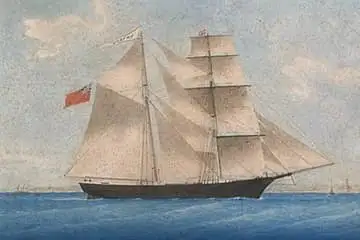
Atlantis (legend). (360 BC vs 1872) Mary Celeste (found adrift) →
Nearby on the globe




Sources
Updated: 2026-10-14