
Białowieża Forest
비아워비에자 숲
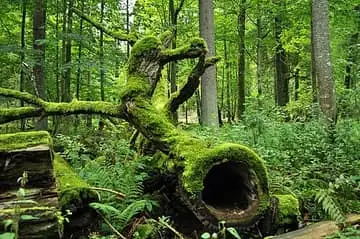
The last large remnant of the primeval lowland forest that once covered the European plain, straddling the Poland–Belarus border (UNESCO); home to the largest free-living population of European bison.
See it on the 3D globe →At a glance
- Country
- Poland
Quick answers
Where is Białowieża Forest?
Białowieża Forest is in Poland.
Białowieża Forest is a big forest on the border between Poland and Belarus, and one of the last and largest pieces of the primeval forest that once spread across the European Plain. It is a UNESCO World Heritage Site and an EU Natura 2000 area, and it covers about 1,419 square kilometres in total.
It is best known as the home of more than 800 European bison, Europe's heaviest land animal. The forest lies about 62 kilometres southeast of Białystok in Poland and 70 kilometres north of Brest in Belarus. The border runs right through it, though there is a crossing for hikers and cyclists. The globe marks it as a nature spot where wild woods and bison are the attraction.
A name from a white tower
The forest is named after the village of Białowieża, which means 'White Tower' in Polish. The name comes from a white wooden hunting manor built there by Władysław II Jagiełło, a Grand Duke of Lithuania who later became King of Poland and loved hunting in these woods.
Until about the 14th century, travel through the forest was mostly by river, and roads and bridges came much later.
Protecting the bison
Rules to protect bison go back at least to 1518. In 1639 a royal decree freed the villagers who lived in the forest in exchange for working as foresters. In the 1800s, the bison were hunted and protected in turns, and the Russian emperors kept the forest as a private hunting reserve.
In World War I, German troops cut about 5 million cubic metres of timber and hunted the animals, and the bison dropped from roughly 700 to 200 within months. Bison were brought back to the Belarusian side in 1929.
Visiting today
The Polish side holds Białowieża National Park, about 105 square kilometres, where guided tours into the strictly protected areas can be taken on foot, by bike or in a horse-drawn carriage. Around 120,000 to 150,000 tourists visit the Polish part each year.
On the Belarusian side, the national park is much bigger at about 1,501 square kilometres. Its headquarters has enclosures where bison, konik horses, wild boar and elk can be seen.
Fun facts
- One of Europe's last primeval forests, it is home to hundreds of European bison, Europe's heaviest land animals.
- The forest's name means 'White Tower' in Polish.
- It holds more than 800 European bison, Europe's heaviest land animal.
- A fertile bison-cattle hybrid was bred here between 1847 and 1859, the only fertile first-generation male known.
- In the 1840s, pine trees covered about two thirds of the forest, spruce about one fifth and oak about one thirteenth.
On the globe
The model shows ancient, tall forest with a European bison, on the Poland and Belarus border.
Nearby on the globe


Sources
Updated: 2026-10-14