
Wawel Castle
바벨 성
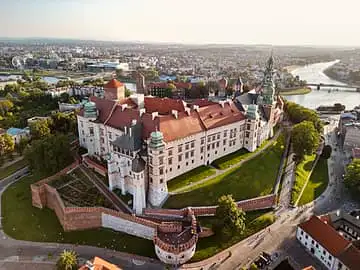
Wawel Castle is a royal castle on Wawel Hill, a limestone hill beside the Vistula River in Kraków, Poland. For centuries, from the 11th to the early 17th century, it was the main home of Poland's kings and the centre of the country's government. Next to the castle stands Wawel Cathedral, where Polish kings were crowned and buried. Many Poles see the hill as the most important historic place in their country.
See it on the 3D globe →At a glance
- Country
- Poland
- Location
- Kraków, Poland
- Built
- 14th c.
- Type
- Castle
Quick answers
Where is Wawel Castle?
Wawel Castle is in Kraków, Poland.
A royal castle on a hill by the Vistula, residence of Polish kings for centuries.
The castle mixes building styles from the Middle Ages, the Renaissance and the Baroque period, because each era added something new. Today it is one of Poland's leading art museums, visited by millions of people a year. In 1978 the Historic Centre of Kraków, including Wawel, became one of the very first places ever added to the UNESCO World Heritage list.
History
Some of the oldest stone buildings on the hill go back to around the year 970. In the 14th century King Casimir III the Great built a Gothic castle here, with several buildings around a central courtyard. After a fire in 1499, King Sigismund I the Old rebuilt it between about 1507 and 1536 as a bright Renaissance palace, with help from Italian craftsmen. Another fire in 1595 led to more rebuilding, but in the early 1600s King Sigismund III Vasa moved the royal court to Warsaw. Later, Austrian soldiers turned the castle into barracks, until they left in 1905 and restoration began.
What's inside
Visitors enter through a large courtyard surrounded by graceful open arcades on slender columns, a famous example of Renaissance design. Inside are the State Rooms, where parliaments met and royal weddings and balls were held, and the Royal Private Apartments. The walls are hung with tapestries woven in Brussels for King Sigismund II Augustus in the 1500s; it is the largest set ever made for a single ruler. The Crown Treasury and Armoury hold royal treasures, including Sigismund I's coronation sword, while another exhibition shows Ottoman tents and art from Asia.
The legend of the dragon
Under the hill is a limestone cave called the Dragon's Den. According to a legend first written down in the 12th century, a fierce dragon lived there and terrorised the town by eating its sheep, until it was defeated, in one version by the legendary prince Krakus, who then founded Kraków on top of the dragon's lair. This is a story, not history, but the cave is real and visitors can walk through it. At the bottom of the hill by the river stands a metal dragon statue that breathes real fire.
Fun facts
- Legend says the Wawel Dragon lived in a cave under the hill.
- The Sigismund Bell in the cathedral's tower weighs almost 13 tonnes and needs 12 bell-ringers to swing it; it is rung only on very special occasions.
- One carved head in the Audience Hall ceiling has a band over her mouth; legend says she once spoke up to tell the king to judge fairly.
- The museum has the largest collection of Ottoman tents in Europe.
- A king who lived here in the 1600s had an alchemy laboratory set up in one of the castle towers.
On the globe
The model shows the royal castle on its hill by the Vistula River in Kraków. Zoom in to see the castle buildings gathered together on top of the hill.
Nearby on the globe

.jpg)
Sources
- Read more on Wikipedia
- Wawel Castle — Wikipedia
- 바벨성 — 위키백과
- Wawel Royal Castle — Karnet Kraków (Kraków Culture)
- Wawel Castle - History and Facts — History Hit
Updated: 2026-10-13