
Boboli Gardens
보볼리 정원
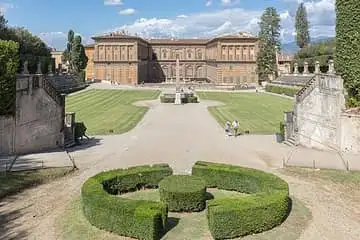
Renaissance garden laid out for the Medici from the 1550s behind the Pitti Palace in Florence, an open-air museum of sculpture; an ancient Egyptian obelisk stands in the middle of its amphitheatre.
See it on the 3D globe →At a glance
- Country
- Italy
- Type
- Park
Quick answers
Where is Boboli Gardens?
Boboli Gardens is in Italy.
The Boboli Gardens are a large park in Florence, Italy, first designed in the mid-1500s as the garden of the Medici family's Pitti Palace. They are an important early Italian garden that inspired the gardens of nobles across Europe. Visitors find statues from many periods, big fountains and artificial caves called grottoes.
The garden lies directly behind the palace, which was the main home of the Medici grand dukes of Tuscany. It uses long straight avenues, wide gravel paths, lots of carved stone and statues, and it opens out to a wide view over the city, which was unusual at the time. Only the Medici family could enter at first. The globe marks it as a garden in Florence.
How it was made
The garden was laid out for Eleonora di Toledo, wife of Cosimo I de' Medici. Niccolò Tribolo began the work but died in 1550, and Bartolomeo Ammanati continued it, with help from Giorgio Vasari and Bernardo Buontalenti. The name may come from an older family who owned the land.
Water came from a spring in the hills through an aqueduct built in the late 1550s, which also supplied fountains in the city. A second aqueduct followed in 1565. The garden was enlarged in the 1600s into its present shape.
Amphitheatre and Neptune
The main path rises from a deep amphitheatre cut into the hillside, shaped like half of an ancient racetrack. An Egyptian obelisk brought from the Villa Medici in Rome stands in its center, and the axis ends at the Fountain of Neptune, seen against the sky from below.
Neptune holds a trident, so the fountain is nicknamed the 'Fountain of the Pitchfork'. The first fountain was made between 1565 and 1568 by Stoldo Lorenzi. The Isolotto, an oval island in a pond, holds the Fountain of the Ocean.
Grottoes and an outdoor museum
The Large Grotto, begun by Vasari and finished by Ammanati and Buontalenti between 1583 and 1593, is decorated inside and out with stalactites. It has three sections, and holds Giambologna's Bathing Venus. Copies of Michelangelo's Prisoners stand there now.
Today the gardens work like an outdoor museum of garden sculpture, with Roman antiquities next to works from the 1500s and 1600s.
Fun facts
- Laid out for the Medici family behind the Pitti Palace in Florence, it is like an open-air museum of statues and fountains.
- The Fontana del Bacchino shows Nano Morgante, a dwarf jester at Cosimo I's court, as the god Bacchus riding a tortoise.
- The Grotto of Vulcan was built in 1617 along the long cypress avenue called the Viottolone.
- The Medici family did not allow anyone outside their close family into the gardens at first.
- The Boboli obelisk is Ancient Egyptian, brought from Rome.
On the globe
The model shows terraces, statues and fountains of the Florence garden behind the Pitti Palace.
Nearby on the globe


Sources
Updated: 2026-10-14