
Leaning Tower of Pisa
피사의 사탑
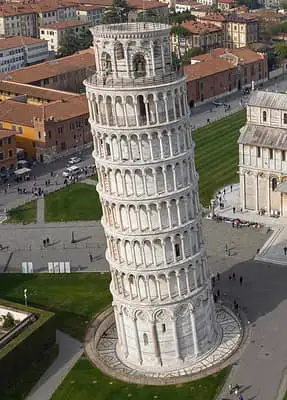
The Leaning Tower of Pisa is the bell tower of Pisa Cathedral in the city of Pisa, in the Tuscany region of Italy. It stands in the Piazza del Duomo, often called the Square of Miracles, next to the cathedral and the round baptistery. The tower is made of white marble, is about 56 metres tall and weighs roughly 14,500 tonnes.
See it on the 3D globe →At a glance
- Country
- Italy
- Location
- Pisa, Italy
- Built
- 1372
- Height
- 56 m
- Type
- Tower
Quick answers
Where is Leaning Tower of Pisa?
Leaning Tower of Pisa is in Pisa, Italy.
When was Leaning Tower of Pisa built?
Leaning Tower of Pisa was built in 1372.
How tall is Leaning Tower of Pisa?
Leaning Tower of Pisa is about 56 m tall.
A cathedral bell tower that began to tilt during construction because of soft ground.
The tower is famous because it leans. It began to tip while it was still being built, because the soft ground underneath could not hold up its heavy weight evenly. Builders worked on it on and off for about 200 years, from 1173 until the bell chamber was added in 1372. Today it leans by about 4 degrees, and more than 5 million people visit it every year, many of them posing for photos as if they were holding it up.
Why does it lean?
The tower was built on a foundation only about 3 metres deep, set in weak, soft soil. In 1178, when builders had reached the second floor, it began to sink on one side. Then work stopped for nearly a hundred years because Pisa was busy fighting wars with nearby cities. That long pause was lucky: it gave the soil time to settle and become firmer. Without it, the tower would probably have fallen over.
How it was built
When building started again in 1272, the engineers tried to correct the tilt by making the upper floors taller on one side than the other. Because of this, the tower is actually slightly curved, like a banana. Work stopped again in 1278 after Pisa lost a sea battle, the seventh floor was finished in 1319, and the bell chamber on top was added in 1372. Historians still do not agree on who first designed the tower.
Saving the tower
Over the centuries the lean kept getting worse, and by 1990 it had reached about 5.5 degrees. That year the tower was closed to visitors. The bells were taken down to make it lighter, and steel cables held it in place. Between 1993 and 2001 engineers carefully removed small amounts of soil from under the high side, so the tower slowly settled back by about 45 centimetres. It reopened in December 2001, and experts say it should stay stable for at least 300 years.
Fun facts
- Stabilising work from 1993 to 2001 reduced its tilt to about 4 degrees.
- The tower has seven bells, one for each note of the musical scale, and the biggest, cast in 1655, weighs about three and a half tonnes.
- A famous story says the scientist Galileo dropped two balls of different weights from the tower to show they fall at the same speed, but historians are not sure it really happened.
- The repairs straightened the tower just enough to put it back where it leaned in 1838.
- Despite looking like a castle tower, it was never used for defence: it is a church bell tower.
On the globe
The model shows the round white marble bell tower with its rows of arches, tilting to one side as it rises. Look at it from the side to see how far the top leans.
Quiz time
Which is taller: Leaning Tower of Pisa or Florence Cathedral?
Show the answer
Florence Cathedral. (56 m vs 114 m) Florence Cathedral →
Nearby on the globe


Sources
- Read more on Wikipedia
- Leaning Tower of Pisa — Wikipedia
- 피사의 사탑 — 위키백과
- Tower — Opera della Primaziale Pisana (official)
Updated: 2026-10-13