
Iceberg Alley
아이스버그 앨리 (빙산 해역)
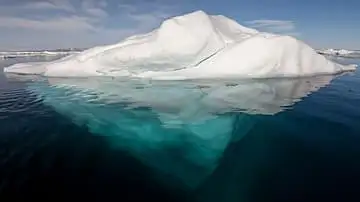
Icebergs calved from Greenland's glaciers drift south on the Labrador Current to the Grand Banks off Newfoundland, mostly in spring. The International Ice Patrol, set up in 1914 after the Titanic disaster, still tracks them here.
See it on the 3D globe →At a glance
- Kind
- Deep sea
An iceberg is a big piece of freshwater ice, longer than 15 metres, that has broken off a glacier or an ice shelf and floats freely in the sea. This spot on the toy globe shows the icebergs that drift past Newfoundland in the North Atlantic. Most of them began as ice in the glaciers of western Greenland.
Only about one tenth of an iceberg sticks up above the water. The rest hides underneath, which is where the saying "the tip of the iceberg" comes from. Icebergs can be dangerous for ships, and that is why they are watched closely.
Why most of it is underwater
Ice made from fresh water has a density of about 920 kilograms per cubic metre, while seawater is about 1,025. Because ice is a little lighter than seawater, it floats, but most of it sinks below the surface. That follows Archimedes' principle of buoyancy. Icebergs may rise more than 100 metres above the sea, and weigh from about 100,000 tonnes to more than 10 million tonnes. The shape under the water is hard to judge from above.
Greenland bergs and giants of Antarctica
Icebergs that calve from Greenland's glaciers usually have irregular shapes, while Antarctic ice shelves often produce flat, table-like icebergs. One of the biggest in recent history was B-15, almost 300 by 40 kilometres in 2000. The largest iceberg on record, seen in 1956, measured 335 by 97 kilometres, which was bigger than Belgium. The largest in the North Atlantic stood 168 metres above the sea in 1958.
Fun facts
- Most icebergs drifting past here broke off glaciers in western Greenland, and about 90% of each berg is hidden underwater.
- Roughly nine tenths of an iceberg is hidden below the water.
- The iceberg seen in 1956 was reported to be larger than the whole country of Belgium.
- Icebergs that drift into the North Atlantic often come from the glaciers of western Greenland.
On the globe
The toy globe marks the iceberg route near Newfoundland, where Greenland's icebergs drift south. Look out over the cold water.
Nearby on the globe





Sources
Updated: 2026-10-14