
Titanic wreck
타이타닉호 난파선
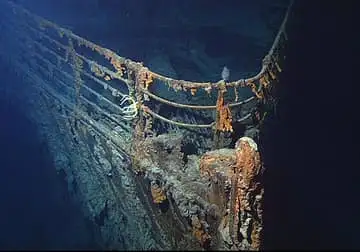
The liner hit an iceberg on her maiden voyage and sank on 15 April 1912, killing about 1,500 people. She lies in two pieces about 3,800 m down south-east of Newfoundland (found 1985); the bow section stands upright, ploughed into the mud.
See it on the 3D globe →At a glance
- Kind
- Shipwrecks
RMS Titanic was a British passenger liner, the largest ship afloat when she entered service. She was built by Harland and Wolff in Belfast for the White Star Line and was about 269 metres long. On her very first voyage, from Southampton to New York, she struck an iceberg and sank in the early hours of 15 April 1912. About 1,500 of the roughly 2,200 people on board died.
For 73 years nobody knew exactly where the wreck lay. Then, on 1 September 1985, a French and American team found it about 3,800 metres down on the floor of the North Atlantic, roughly 600 km south-southeast of Newfoundland, Canada. The wreck is now a protected underwater heritage site and a grave for those who were lost.
What happened
Titanic set out on 10 April 1912. On the night of 14 April she hit an iceberg in the North Atlantic, began to flood, and sank in the early hours of the next morning. She carried only 20 lifeboats, with room for about 1,178 people, roughly half of everyone on board. That shortage is a big reason so many people died. Her story has been told in books, films and museums ever since, and her name is still known all over the world.
How the wreck was found
The search was a joint effort by the French ocean institute IFREMER, led by Jean-Louis Michel, and the Woods Hole Oceanographic Institution in the United States, led by Robert Ballard. The French ship first scanned most of the search area with sonar. Then the American ship Knorr towed Argo, a brand-new underwater camera sled. Instead of looking for the hull, the team followed a trail of debris scattered by the currents. Just after 1 a.m. on 1 September 1985, a boiler appeared on the screen, and the ship was found.
What scientists found
The ship broke in two as it sank. The bow, the front part, landed fairly whole and is stuck upright in the mud, while the stern lies about 600 metres away, badly crushed. Thousands of objects are scattered across the sea floor around them. Rust-eating bacteria, including a species named Halomonas titanicae after the ship, form icicle-like "rusticles" that slowly eat away the iron. Scientists expect the wreck to keep crumbling, and it is too fragile to raise.
Fun facts
- The wreck was not found until 1985, 73 years after the ship sank.
- The team found Titanic by following a trail of scattered debris, not by searching for the hull.
- A kind of rust-eating bacteria found on the wreck is named Halomonas titanicae.
- The bow and the stern lie about 600 metres apart on the sea floor.
- Titanic had lifeboat room for only about half the people on board.
On the globe
The model shows the Titanic wreck in two pieces about 3,800 m down south-east of Newfoundland. Look for the bow section standing upright, ploughed into the mud.
Quiz time
Which is older: Titanic wreck or Mary Rose (Henry VIII's warship)?
Show the answer
Mary Rose (Henry VIII's warship). (1912 vs 1545) Mary Rose (Henry VIII's warship) →
Nearby on the globe




Sources
- Read more on Wikipedia
- Wreck of the Titanic — Wikipedia
- Titanic — Wikipedia
- 1985 discovery of RMS Titanic — Woods Hole Oceanographic Institution
Updated: 2026-10-13